
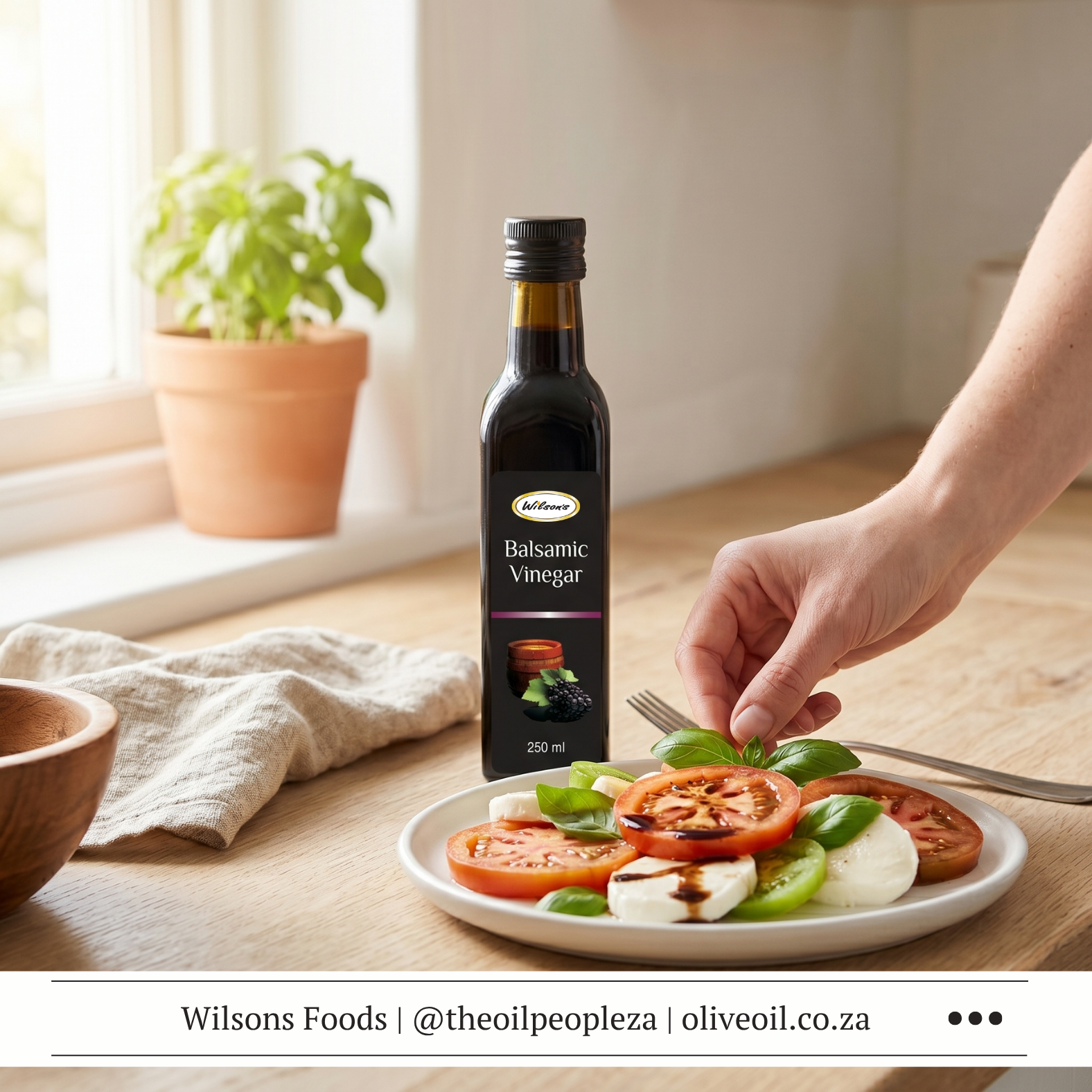
Most people know balsamic vinegar for salad dressing and Caprese. Fair enough — it’s good at both. But the one that stops people mid-bite is the strawberries. Halved strawberries, a drizzle of balsamic, a pinch of black pepper, fifteen minutes to sit. That’s it. Once you’ve tried it, you’ll wonder what else you’ve been missing.
Below are eight ways we use Wilson’s Foods Balsamic Vinegar — including a few that might surprise you. There are recipe links throughout for each one. Start wherever the mood takes you.
We Use Wilson’s Foods Balsamic Vinegar
Wilson’s Foods Balsamic Vinegar is imported from Modena, Italy — the birthplace of balsamic vinegar. It has that balance of sweet and sharp that makes it work across a genuinely wide range of dishes — savoury, sweet, cold, warm. The depth comes from the grape must base, and it behaves consistently whether you’re reducing it in a pan or pouring it straight from the bottle over something fresh.
In a pan, it reduces quickly — too much heat and it burns, so keep it medium and keep an eye on it. In a dressing it emulsifies well with olive oil and a bit of honey or Dijon mustard. And over fruit, particularly strawberries, it does something that takes most people by surprise the first time they try it. The acidity pulls the sweetness forward. It tastes like the fruit is more itself.
It’s Halaal certified, vegan, and contains no artificial flavourants. Store it in a cool, dark place — no refrigeration needed — and it keeps well for a long time.
Our Tips
Watch the heat when reducing — balsamic has a high sugar content and it catches quickly. Use medium heat, not high, and pull it off the stove a few seconds before it looks done. It thickens further as it cools.
Let it macerate — when using balsamic with strawberries or other fruit, give it ten to fifteen minutes to sit before serving. The fruit releases juice and the balsamic softens. The result is entirely different to just pouring it over at the last second.
Use it in your biltong cure — a small amount of balsamic in the cure adds depth and a faint sweetness that works with the salt and coriander. It’s not traditional, but it’s worth trying once.
Pair it with fat — balsamic on its own can be sharp. With olive oil, with cheese, with avocado — something fatty alongside it rounds out the acidity and makes the whole thing more balanced.
The glaze keeps — if you make a balsamic reduction, pour the leftovers into a small jar and keep it in the fridge. It lasts for weeks and the drizzle-over-everything convenience is genuinely useful.
Start with less than you think — balsamic is assertive. In a dressing, in a marinade, over fruit — you can always add more, and you can’t take it out.
How We Serve It
The Caprese is the obvious starting point — sliced tomato, fresh mozzarella, basil leaves, a drizzle of Wilson’s Foods Balsamic Vinegar and olive oil, sea salt. On a warm day with good tomatoes, it’s hard to improve on. The balsamic goes on last, in a thin line, not pooled underneath everything.
For bruschetta, the balsamic goes into the tomato mix and also gets drizzled over the top just before serving. The double application gives you the flavour throughout and then a fresh hit on top. Sourdough works better than baguette for this — it holds up to the juice without going immediately soft.
For something that genuinely surprises people — halved strawberries in a bowl, a drizzle of balsamic, a pinch of black pepper, fifteen minutes to macerate, served as-is or over vanilla ice cream. That black pepper and balsamic combination with strawberries is one of those things that sounds odd and tastes completely right.
More Ways to Use Wilson’s Foods Balsamic Vinegar
Wilson’s Foods Balsamic Vinegar works across more ground than most people give it credit for. Here are eight places to start:
Biltong and Caprese Salad with Olive Oil Balsamic Dressing — thinly sliced biltong over fresh mozzarella, tomatoes and basil, dressed with balsamic and olive oil. South African and Italian in the same bowl, and it works completely. Get the recipe.
Balsamic Cured Beef Jerky — balsamic in the cure adds a layer of depth alongside the salt and spice that plain vinegar doesn’t give you. Get the recipe.
Balsamic-Infused Strawberries — halved strawberries, balsamic, a pinch of black pepper, fifteen minutes to sit. The combination is the kind of thing you’ll keep coming back to once you’ve tried it. Get the recipe.
Caprese-Inspired Avocado with Balsamic Vinegar — avo, sliced tomato, fresh basil and a balsamic drizzle. The fat in the avocado softens the acidity of the balsamic in exactly the right way. Get the recipe.
Balsamic Bruschetta — tomatoes, basil, garlic and balsamic on toasted sourdough. The balsamic goes into the mix and over the top. Double application, properly good result. Get the recipe.
Grilled Lime-Balsamic Sweet Potatoes — sweet potatoes on the braai grid with a lime and balsamic glaze that caramelises as they cook. One of those sides that disappears before the meat is ready. Get the recipe.
Balsamic Glaze — balsamic reduced in a pan until thick and sticky. Pour it over everything. Grilled chicken, roasted veg, pizza, vanilla ice cream. It keeps in a jar in the fridge for weeks. Get the recipe.
Balsamic Herb Vinaigrette — balsamic, olive oil, Dijon, garlic, fresh herbs, a little honey. Shake it in a jar. Use it all week on salads, grain bowls, roasted vegetables, cold chicken. Get the recipe.
The Good Stuff
Wilson’s Foods Balsamic Vinegar is made from grape must and wine vinegar — no artificial flavourants, no added colour. It’s vegan, dairy-free, and Halaal certified. The acidity is what makes it work as both a condiment and a cooking ingredient — it brightens other flavours when used in small amounts and becomes a flavour in its own right when reduced or used more generously.
Balsamic vinegar contains antioxidants from the grape must base and has a lower glycaemic index than many sweeteners, which makes it a useful way to add sweetness to dressings and marinades without leaning on sugar. Store it at room temperature in a cool, dark place — no refrigeration needed. It keeps well and the flavour actually improves slightly over time.
Ways to Change It Up
Make it a fig balsamic — add a spoonful of fig jam to the reduction pan alongside the balsamic. The result is deeper, slightly fruity, and works particularly well over camembert or brie on a cheese board.
Add honey to the glaze — a teaspoon of honey stirred into the reducing balsamic gives it a rounder, more complex sweetness and makes it cling better to grilled chicken or pork.
Swap the protein in the Caprese — the biltong and Caprese combination is worth trying, but grilled chicken, smoked salmon, or thinly sliced prosciutto all work just as well with the balsamic dressing.
Try it with peaches or nectarines — the same maceration trick that works with strawberries works beautifully with stone fruit in summer. Halved, a drizzle of balsamic, twenty minutes. Serve over yoghurt or vanilla ice cream.
Use it in a braai marinade — balsamic, olive oil, garlic, fresh rosemary and a little brown sugar. Works on lamb, chicken, pork ribs. The sugar and balsamic together caramelise on the grid and give you a glaze without any extra effort.
Go plant-based — the balsamic herb vinaigrette and the grilled sweet potatoes are both completely plant-based as written. The biltong Caprese works with smoked tofu or grilled halloumi in place of the meat for a vegetarian version that holds its own.
Questions You Might Have
Can I substitute red wine vinegar for balsamic vinegar?
Red wine vinegar is sharper and has none of the sweetness that balsamic gets from the grape must. In a dressing it can work if you add a little honey alongside it, but in a reduction or over fruit it’s a different result entirely. Balsamic is worth keeping as its own thing.
How do I make a balsamic reduction without burning it?
Medium heat, not high. Pour the balsamic into a small saucepan and let it come to a gentle simmer. Stir occasionally. When it coats the back of a spoon and has reduced by roughly half, take it off the heat. It continues to thicken as it cools, so pull it a little earlier than looks right.
Does balsamic vinegar need to be refrigerated?
No — store it at room temperature in a cool, dark place. The acidity acts as a natural preservative. If you’ve made a balsamic reduction or glaze, that can go in the fridge in a sealed jar where it will keep for several weeks.
My balsamic dressing separated — is that normal?
Completely normal. Oil and vinegar don’t emulsify permanently without an emulsifier like Dijon mustard or honey. Shake the jar before each use. If you want a more stable dressing, add a small spoonful of mustard when you make it — it holds the emulsion together considerably longer.
Is Wilson’s Foods Balsamic Vinegar Halaal certified?
Yes — Wilson’s Foods Balsamic Vinegar is Halaal certified. It contains no artificial flavourants or colourants and is suitable for vegetarian and vegan diets.
Where can I buy Wilson’s Foods Balsamic Vinegar?
Wilson’s Foods Balsamic Vinegar is available online at oliveoil.co.za and at leading retailers across South Africa.
How much balsamic vinegar should I use in a dressing?
A standard ratio is one part balsamic to two or three parts olive oil, depending on how sharp you want the result. Start with one tablespoon of balsamic and build from there — it’s easier to add than to fix an overdressed salad.
Ready to Start Using It?
Wilson’s Foods Balsamic Vinegar is available online and at leading retailers across South Africa.
Shop Now More RecipesMore From Our Kitchen
Chilli & Garlic Prawns — Cheesy Onion Soup — Roasted Tomato Soup with Basil Oil — Braai Potato Salad with White Truffle Oil — All Recipes
Made this? We’d love to see.
Tag us @theoilpeopleza · #WilsonsFoods