
At some point a wellness influencer got ahold of an end of a stick (the wrong end) and canola oil became a villain. People who had been cooking with it for thirty years quietly moved it to the back of the cupboard. Some replaced it with coconut oil. Some switched to olive oil for everything. A few stopped buying it altogether, convinced that something industrial and dangerous had been hiding in their pantry all along.
It had not. Canola oil is one of the most researched cooking oils on the planet, with one of the most thoroughly established safety records in food science. What it has suffered from is a gap between what the peer-reviewed evidence actually says and what performs well on social media. That gap is worth closing — and the story behind it is more interesting than the fear.
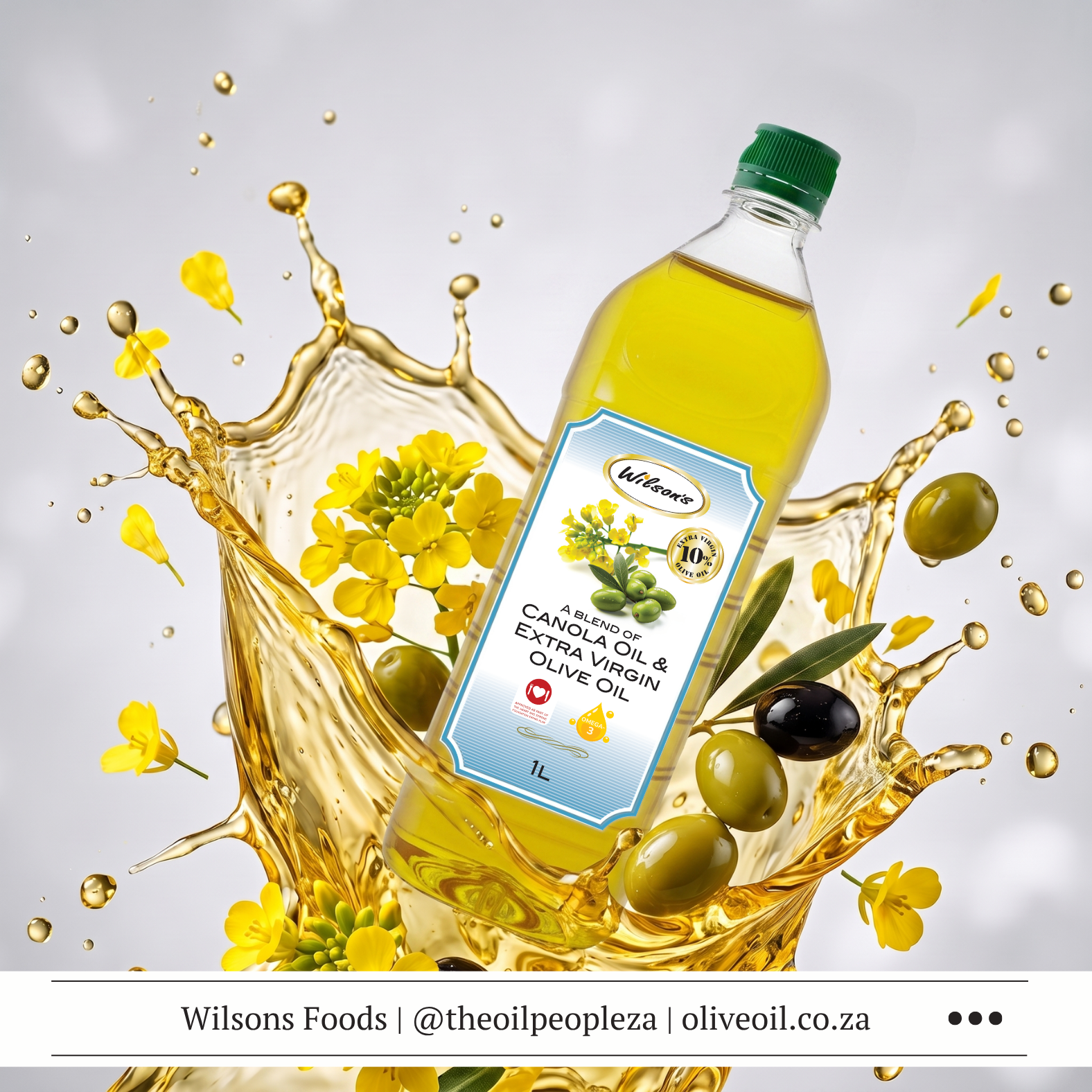
Let’s dig into what the science say and how our Wilson’s Sky 10% Olive Oil Blend — endorsed by the South African Heart and Stroke Foundation — fits into it.
Where Canola Oil Comes From
The canola plant is a variety of rapeseed (Brassica napus) developed by Canadian agricultural scientists in the 1970s. The name is a contraction — “Can” for Canada, “ola” for oil, “la” for low acid. That last part is the key to understanding the whole story.
The original rapeseed plant had been used for industrial lubrication for centuries. It contained high concentrations of erucic acid — a long-chain fatty acid that, in very large quantities, caused cardiac damage in rats in laboratory studies. It also contained elevated levels of glucosinolates, bitter compounds that made the seed meal unsuitable for animal feed. For those reasons, traditional rapeseed oil was never developed for human consumption.
What Canadian plant breeders achieved through conventional cross-breeding — not genetic modification — was a fundamentally different crop. The double-low canola varieties developed by the mid-1970s reduced erucic acid to below two per cent of total fatty acids and cut glucosinolate content by 70 to 90 per cent. The first commercial cultivar, Tower, was registered in 1974. By 1985, the US Food and Drug Administration had granted canola oil GRAS status — Generally Recognized as Safe — for use in human foods. That classification has not been revised in the four decades since.
Modern canola oil and traditional rapeseed oil are not the same thing. Using the reputation of one to condemn the other is like blaming a bitter wild ancestor for the flavour of a cultivated crop.
What Is Actually in the Bottle
Canola oil has a fatty acid profile that nutritional researchers consistently describe as one of the most balanced of any common cooking oil. Roughly 62 to 65 per cent of its fat content is oleic acid — the same heart-healthy monounsaturated fat that makes extra virgin olive oil so widely recommended. Around 20 per cent is linoleic acid, an omega-6 polyunsaturated fat. Approximately nine to 12 per cent is alpha-linolenic acid (ALA), a plant-based omega-3. Saturated fat sits at around seven per cent — lower than virtually every other widely used cooking oil, including coconut oil at 90 per cent saturated and palm oil at 50 per cent.
That omega-3 content is worth noting. Most cooking oils contain essentially no plant-based omega-3 fatty acids. Canola oil is one of the few that does, at an omega-6 to omega-3 ratio of approximately 2:1 — a balance nutritionists consider broadly beneficial, given that most modern diets already carry a significant omega-6 surplus. Canola oil also contains vitamin E in the form of alpha-tocopherol, a natural antioxidant that contributes to both the oil’s stability and its nutritional profile.
The table below shows the actual independently verified results for Wilson’s 10% Olive Oil Blend,
| Nutrient | Per 100g | Per 15ml serving |
|---|---|---|
| Energy | 3 693 kJ | 529 kJ |
| Total Fat | 99.67 g | 13.64 g |
| of which Saturated Fat | 7.89 g | 1.08 g |
| of which Monounsaturated Fat | 64.29 g | 8.80 g |
| of which Polyunsaturated Fat | 27.49 g | 3.76 g |
| of which Trans Fat | 0.00 g | 0.00 g |
| Omega-3 Fatty Acids ✓ Very High | 9.997 g (9 997 mg) | 1 368 mg |
| of which ALA | 9.748 g | 1 333 mg |
| of which EPA | 0.250 g | 34 mg |
| Omega-6 Fatty Acids | 17.5 g | 2.39 g |
| Cholesterol | <5 mg | <1 mg |
| Sodium | 1.02 mg | 0.14 mg |
| SServing size: 1 tablespoon (15ml). Omega-3 claim verified under R.146/2010, Clause 12(c) & Guideline 5. | ||
The omega-3 figure is the one that stands out. At 1 368 mg per 15ml serving, the Sky 10% Blend qualifies as Very High in Omega-3 Fatty Acids under South African food labelling regulations (R.146/2010) — the highest tier of omega-3 claim permitted, requiring a minimum of 300 mg per single serving. Trans fat content is zero. Saturated fat is under eight per cent.
What the Institutions Actually Say
This is where the social media narrative and the scientific record diverge most sharply.
In 2026, the American Heart Association published its updated Dietary Guidance to Improve Cardiovascular Health — a formal Scientific Statement in Circulation, the AHA’s flagship peer-reviewed journal. The statement explicitly names canola oil alongside olive oil as a component of heart-healthy dietary patterns and recommends it as a preferred source of unsaturated fat for lowering coronary heart disease risk. The AHA’s Healthy Cooking Oils guidelines list it alongside olive oil, recommended in place of butter, lard, and tropical fats.
Locally, Wilson’s Sky 10% Olive Oil Blend carries the endorsement of the South African Heart and Stroke Foundation — recognition that requires the product to meet specific nutritional criteria for cardiovascular health. That endorsement is grounded in exactly the kind of independently verified data shown in the table above.
Beyond the AHA, the American Diabetes Association, the Academy of Nutrition and Dietetics, and the American Academy of Family Physicians all list canola oil as a healthy fat source in their dietary guidance. The Harvard T.H. Chan School of Public Health places it among recommended sources of healthy unsaturated fats.
A peer-reviewed analysis published in Nutrition Reviews, drawing on clinical studies examining canola oil’s direct effects on cardiovascular markers, found consistent, meaningful reductions in total cholesterol and LDL cholesterol compared with saturated fat sources.
The Claims That Keep Circulating
It is a toxic industrial oil. The confusion traces directly back to traditional rapeseed — used for industrial lubrication before canola was developed. The two are different plants with significantly different chemical compositions. Canola oil contains less than two per cent erucic acid. Traditional rapeseed oil contained up to 50 per cent. The concern about erucic acid was resolved by the plant itself, through decades of targeted breeding, before canola ever reached a supermarket shelf.
The processing uses bleach. It does not. The refining of canola oil — like most refined cooking oils — involves steps described in industry terminology as bleaching and deodorising. These refer to filtration through natural clay, which removes colour pigments, and steam treatment, which removes volatile odour compounds. No chlorine bleach is involved at any stage.
It is full of trans fats. The lab result above puts this to rest. Trans fat content in Wilson’s Sky 10% Blend is 0.00 g per 100g — verified by an independent, SANAS-accredited laboratory. As Tufts University’s School of Nutrition Science and Policy has confirmed, trace formation during processing is negligible — well below the naturally occurring trans fat levels found in beef and full-fat dairy.
Omega-6 causes inflammation. There is a genuine underlying principle here. The omega-6 to omega-3 ratio in modern diets is often too high, and a significant imbalance over time can contribute to chronic inflammation. But canola oil is one of the oils that helps address that imbalance rather than worsen it. In Wilson’s Sky 10% Blend, the lab-verified omega-6 to omega-3 ratio is approximately 1.75:1 — better than most alternatives on the shelf, and significantly better than pure sunflower or corn oil.
What This Oil Does Well in the Kitchen
The Sky 10% Blend has a smoke point comfortably suited to everyday home cooking — sautéing, roasting, stir-frying, and baking — without the oil breaking down or producing the bitter compounds that degraded oils release. It is liquid at room temperature, stable in storage, and neutral enough in flavour to disappear into a dish rather than compete with it.
For baking, that neutrality is the point. When the fat’s job is to add moisture and structure without flavour — a light sponge, a batch of muffins, a vinaigrette built around its other ingredients — a neutral, stable oil is the right tool. For sautéing aromatics, browning chicken, stir-frying vegetables, and braai bastes at heat, it performs reliably. The olive oil fraction adds a gentle quality and nutritional depth that pure canola alone cannot match.
It is also the oil preferred by many of Wilson’s hospitality industry clients — professional kitchens that need consistent, reliable performance across hundreds of covers a week. That is about as practical an endorsement as any home cook could ask for.
How to Store It
Store in a cool, dark place — away from the stovetop, where heat cycles degrade any oil over time. An unopened bottle kept properly will last up to 24 months. Once opened, use it within a year. If it smells sharp, bitter, or vaguely chemical, it has oxidised and should be replaced. Fresh canola-olive oil smells clean, mild, and faintly grassy. That is what you are looking for.
Ready to Cook With It?
Wilson’s Sky 10% Olive Oil Blend is endorsed by the South African Heart and Stroke Foundation, verified Very High in Omega-3 Fatty Acids, and available online and at leading retailers across South Africa.
More From Our Kitchen
Vegan Chocolate Coconut Cake — Chicken Burger — Spicy Thai Peanut Chicken — Baked Date Cheesecake — All Recipes
What do you use your everyday cooking oil for most? Tell us in the comments below.
Tag us @theoilpeopleza · #WilsonsFoods