
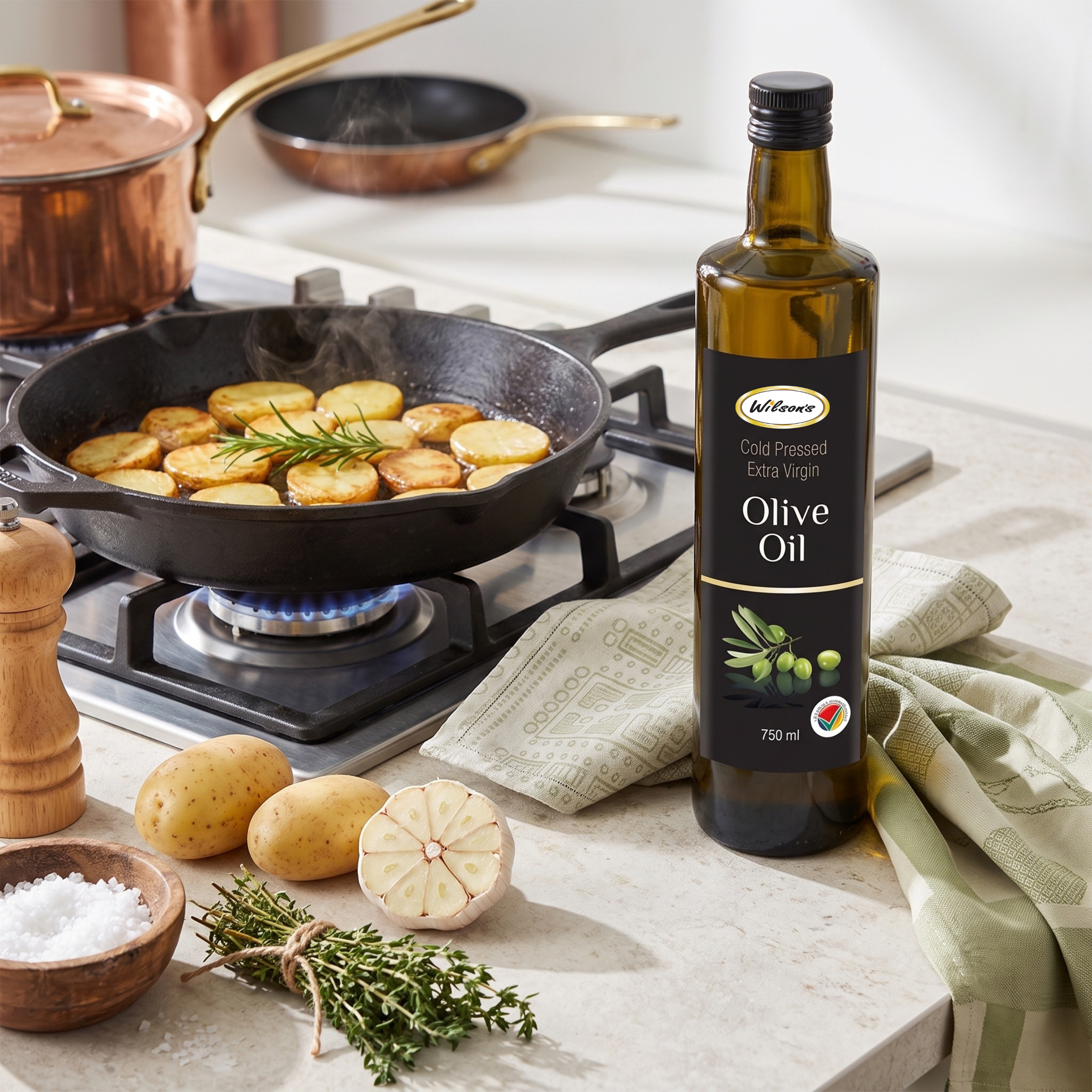
Heat a pan of oil too far and you’ll see it before you taste it. A thin blue haze lifts off the surface — the clearest sign an oil has broken past its limit. That limit has a name, the smoke point, and it sits at a different temperature for every oil on the shelf, which is exactly why one bottle can’t do every job in the kitchen.
Wilson’s range covers a wide spread of that scale, from a plain extra virgin right through to a tub of coconut oil, and knowing which oil for which heat takes the guesswork out of reaching for the wrong one. This week’s Spanish-style olive oil tortilla makes the point well — shallow-frying potatoes in a generous pool of oil only works if that oil can actually hold the heat without breaking down first.
Here’s a straightforward guide to where each bottle sits on the heat scale, and which one to reach for next time.
Why Smoke Point Matters
Smoke point is the temperature where an oil stops cooking food properly and starts breaking down instead, giving off visible smoke and a bitter, acrid flavour that no amount of seasoning fixes afterward. Push any oil past that point for long enough and both the flavour and some of its nutritional value go with it.
It’s not the only number worth watching, though. A highly refined oil might tolerate more heat on paper, but a well-made extra virgin or flavoured oil often performs better at the temperatures most home cooking actually reaches — searing, roasting, shallow-frying — which rarely climb past 220°C even in a hot oven.
The hottest oil in the cupboard isn’t automatically the right one for the job. The right one is whichever one suits what’s actually happening in the pan.
Which Wilson’s Oil for Which Heat
Extra Virgin Olive Oil — The idea that extra virgin can’t handle heat is mostly myth. A good one holds up for home cooking at roughly 175°C to 210°C, which covers sautéing, roasting and shallow-frying without issue. Wilson’s Extra Virgin Olive Oil is the one that gets reached for most, hot or cold.
Peri-Peri Flavoured Oil — Built on the same olive and canola base, Wilson’s Peri-Peri Flavoured Oil handles the heat of a braai grid well as a basting oil, carrying chilli and paprika evenly through a long session at the fire.
Garlic Flavoured Oil — Wilson’s Garlic Flavoured Oil is better suited to a moderate pan — a stir-fry or the base of a sauce — rather than the hottest burner in the kitchen. Garlic itself scorches quickly, and the infused oil follows the same lower ceiling.
Rosemary Flavoured Oil — Wilson’s Rosemary Flavoured Oil holds up to marinades, bastes and a hot oven tray or braai grid without losing the herb character it’s built around.
Basil Flavoured Oil — Wilson’s Basil Flavoured Oil does its best work at low heat or none at all — stirred through warm pasta off the stove, or whisked into a dressing where the flavour stays bright instead of fading in the pan.
Coconut Oil — Wilson’s Coconut Oil is solid at room temperature and genuinely high-heat capable, a good match for a hot wok or the base of a curry that needs real heat alongside a touch of natural sweetness.
Our Tips
Trust what you see, not the time on the clock. A faint shimmer across the surface means it’s ready. Visible smoke means it’s already gone too far.
Save flavoured oils for a pan they’ll actually be tasted in. Garlic or basil oil loses most of its character in a screaming-hot pan.
Reach for a plain oil when the pan genuinely needs to be hot. Extra Virgin Olive Oil or Coconut Oil handle that job better than a delicate flavoured oil.
Finish dishes with oil as often as you cook with it. A raw drizzle at the end brings back whatever character the heat muted along the way.
Don’t judge heat tolerance by colour alone. A deep golden oil isn’t automatically more heat-stable than a paler one — it comes down to how it was made, not how it looks.
Keep bottles away from the stove itself. Heat and light both shorten an oil’s shelf life, even one that hasn’t been opened yet.
Matching the Oil to the Dish
Shallow-frying puts an oil’s real limits to the test, since the food sits in direct contact with hot oil for several minutes rather than a quick sear. This week’s olive oil tortilla relies on exactly that — potatoes and onion cooked slowly in a generous pool of Wilson’s Extra Virgin Olive Oil until soft, not crisp, before they ever meet the egg.
A braai is a different test altogether. The heat is far less controllable than a stovetop, which is why a basting oil needs to survive flare-ups without turning bitter — exactly what the Peri-Peri and Rosemary oils are built to do.
Anything finished at the table — a salad, a bowl of soup, a plate of bread — barely touches heat at all, and that’s where the more delicate oils in the range do their best work.
Questions You Might Have
Can extra virgin olive oil really handle high heat?
Yes, a good one is stable for home cooking at roughly 175°C to 210°C, which comfortably covers sautéing, roasting and shallow-frying. The idea that it can’t take heat is one of the more persistent oil myths.
Which oil works best for basting on the braai?
Peri-Peri and Rosemary Flavoured Oils both hold up well over an open flame, carrying their flavour through a long basting session without turning bitter.
Why does a flavoured oil taste weaker once it’s been cooked?
Heat mutes the volatile compounds that carry most of an oil’s aroma. A raw drizzle at the end of cooking usually tastes sharper than the same oil used earlier in the pan.
Is coconut oil suited to South African cooking?
Yes, it handles high heat well and works nicely in a hot wok or a curry base that benefits from a touch of natural sweetness alongside the heat.
What’s the right oil for shallow-frying something like a tortilla?
Extra Virgin Olive Oil handles shallow-frying comfortably at home-cooking temperatures, which is exactly what it’s doing in our Spanish-style olive oil tortilla.
Do the flavoured oils have a shorter shelf life than the plain ones?
Not meaningfully, Wilson’s flavoured oils carry roughly the same two-year shelf life as the plain range, provided they’re stored in a cool, dark spot away from the stove.
Where can I buy Wilson’s oils?
The full range is available to order directly from oliveoil.co.za and at leading retailers across South Africa.
Ready to Stock Up?
A different oil for every pan means nothing smokes and nothing goes to waste.
More From Our Kitchen
Roast Potatoes — Cabbage Steaks — Braai Marinades That Impress — All Recipes
Made this? We’d love to see
Tag us @theoilpeopleza · #WilsonsFoods