
No-knead bread isn’t a shortcut dreamed up for people short on time. It’s closer to how bread was made before kneading became the standard step everyone assumes it is. Written recipes for it go back centuries, including one printed in an English cookbook from 1739, long before anyone thought to write “knead” into a recipe at all. The method faded once kneading took over, until a New York baker’s version made headlines decades later and sent home bakers back to the same long, slow rise.
Our No-Knead Olive Oil Bread leans into that same patience, with one change: Wilson’s Extra Virgin Olive Oil goes into the dough itself, not just brushed over the crust once it’s baked.
Here’s our full No-Knead Olive Oil Bread, from the first mix to the last slice while it’s still warm.
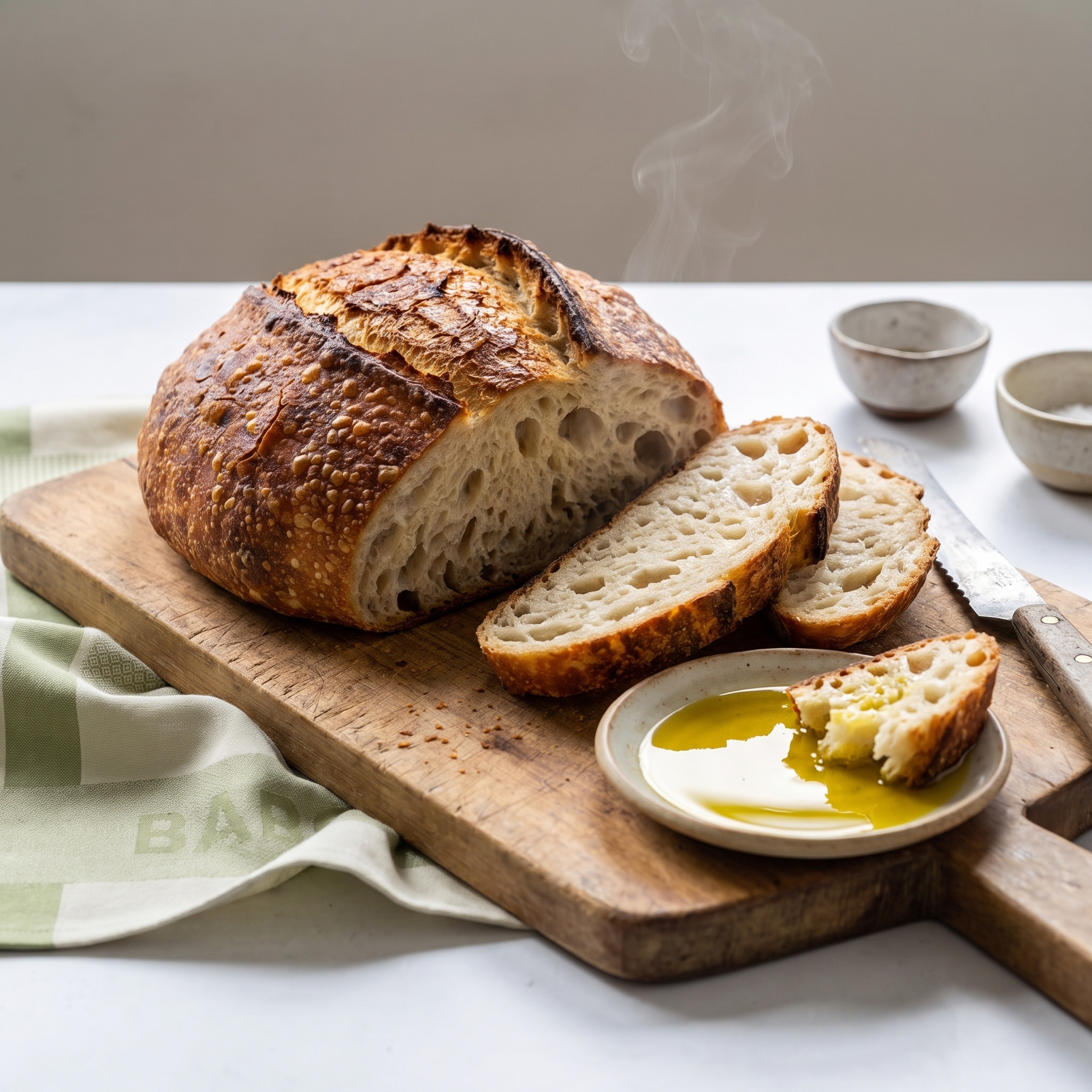
No-Knead Olive Oil Bread
Ingredients
Method
- In a large bowl, whisk together the flour, yeast and salt.
- Add the Wilson’s Extra Virgin Olive Oil and water, and mix with a wooden spoon or your hand until no dry flour remains. The dough will be shaggy, wet and sticky; that’s correct.
- Cover the bowl with cling film or a damp tea towel and leave at room temperature for 12 to 18 hours, until doubled in size and covered in bubbles.
- Turn the dough out onto a well-floured surface. Fold it over itself a few times, then shape it into a rough ball.
- Place the dough on a sheet of floured baking paper, cover loosely, and leave to rise for another 1-2 hours until puffy.
- About 30 minutes before baking, place a heavy lidded pot (cast-iron or enamelled) into the oven and preheat to 230C.
- Carefully lower the dough, still on its baking paper, into the hot pot. Cover with the lid and bake for 30 minutes.
- Remove the lid and bake for a further 15 minutes, until the crust is deep golden brown.
- Lift the bread out of the pot and let it cool on a wire rack for at least 30 minutes before slicing.
Notes
We Use Extra Virgin Olive Oil
Most bread recipes treat olive oil as a finishing touch, brushed over the crust for shine after the loaf comes out of the oven. This one puts Wilson’s Extra Virgin Olive Oil into the dough itself, mixed in alongside the flour and water before the long rise even starts.
Worked into the dough this way, the oil coats the gluten strands as they develop during that slow, unattended rise, which keeps the crumb soft and moist for days instead of going dry and stale by the next morning. It also carries flavour through the entire loaf rather than leaving it sitting only on the surface.
The result is a loaf with a shatter-crisp crust from the hot pot it bakes in, and a crumb that stays tender because of what’s mixed in long before it ever sees the oven.
Our Tips
Don’t rush the first rise. A full 12 to 18 hours is what builds the gluten structure that kneading would normally do, so give it the time it needs.
Use a heavy pot with a lid. A cast-iron or enamelled pot traps steam in the first part of baking, which is what gives the crust its crackle.
Preheat the pot properly. A cold pot means a slow start and a denser loaf, so give it a full 30 minutes in the oven before the dough goes in.
Keep the dough wet. It should look shaggy and sticky, not smooth. A dough you can knead by hand is too dry for this method.
Let it cool before cutting. The crumb is still setting in the first hour out of the oven, even though the smell makes that hard to believe.
Flour your hands, not the dough. Wet hands make a sticky mess; floured hands make shaping the dough far easier at the end of the rise.
How We Serve It
Warm, torn by hand, and dipped in more olive oil is really all this bread needs. A shallow dish of Wilson’s Extra Virgin Olive Oil with a little salt and pepper alongside turns a loaf into a proper starter.
It also holds up well next to a pot of soup or a braai, where something is needed to mop up whatever’s left on the plate. A loaf like this doesn’t last long once it’s cut, so we tend to make two.
Leftover slices toast beautifully the next day, which is reason enough to bake more than you think you need.
More Ways to Use Extra Virgin Olive Oil
A bottle of Wilson’s Extra Virgin Olive Oil earns its place well beyond one loaf of bread.
For a Sunday side — it replaces the butter entirely in our Roast Potatoes, finished in the oil instead.
For a slow Sunday pot — it builds the base of our Slow-Braised Oxtail Stew.
For a simple vegetable side — it’s poured raw over our charred Cabbage Steaks.
For another bake entirely — it goes into the dough, the tray and the toppings of our Three Flavour Focaccia.
The Good Stuff About Extra Virgin Olive Oil
“Extra virgin” is a grade, not just a label. It means the oil was extracted mechanically, using pressure alone, with no heat and no chemical solvents involved, which is what gives it that peppery, grassy character next to a refined oil.
Halaal & Kosher
Certified
Vegan, Vegetarian & Hindu
Suitable For
250ml, 500ml, 750ml, 1L, 2L, 5L
Bottle Sizes
2 Years, Cool & Dark
Shelf Life
Ways to Change It Up
Add herbs to the dough. A tablespoon of dried rosemary or oregano mixed in before the first rise gives the loaf a different character entirely.
Fold in olives. Pitted, roughly chopped olives folded in during shaping add pockets of salt and brine through the crumb.
Swap in wholewheat flour. Replacing up to half the white flour with wholewheat gives a nuttier loaf, though it won’t rise quite as high.
Go smaller for dinner rolls. Divide the dough into portions before the second rise for individual rolls instead of one large loaf.
Add a seeded crust. Rolling the shaped dough in sesame or poppy seeds before it goes into the pot adds texture to the crust.
Questions You Might Have About No-Knead Olive Oil Bread
Why is the dough so wet and sticky?
A high hydration dough is what lets the long rise do the work that kneading would normally do. It should look shaggy, not smooth, right up until it’s shaped.
Do I really need to let it rise for 12 to 18 hours?
Yes, the long rise is what builds the gluten structure in place of kneading. Cutting it short gives a denser, less airy loaf.
Can I use a regular pot instead of a cast-iron one?
Any heavy, oven-safe pot with a tight-fitting lid works. The key is that it traps steam in the first part of baking.
Why does olive oil go into the dough instead of just on top?
Mixed into the dough, the oil coats the gluten as it develops, which keeps the crumb soft for days rather than only flavouring the crust.
How do I store the bread once it’s baked?
Keep it cut-side down on the counter for up to 3 days, or freeze whole once fully cooled for up to a month.
Can I make this without a Dutch oven?
Yes, any heavy pot with a lid that can go in a hot oven will work in its place.
Where can I buy Wilson’s Extra Virgin Olive Oil?
It’s available to order directly from oliveoil.co.za and at leading retailers across South Africa.
Ready to Make This?
Get the oil that goes into the dough, not just over the crust.
More From Our Kitchen
Homemade Roosterkoek — Vegan Garlic Bread — Olive Oil Dip with Warm Bread — All Recipes
Made this? We’d love to see
Tag us @theoilpeopleza · #WilsonsFoods