
Ask a room full of Spaniards whether a proper tortilla de patatas needs onion, and you’ll get a proper argument. It’s one of the country’s oldest kitchen debates, provincial loyalty and family recipe both staked on one side or the other, and neither camp is backing down any time soon. What everyone agrees on, onion or no onion, is the method underneath it — potatoes cooked low and slow in a generous pool of olive oil until they turn almost custard-soft, long before the egg ever gets involved.
This Spanish olive oil tortilla sides with onion, built on potatoes and onion poached gently together in Wilson’s Extra Virgin Olive Oil until they’re ready to fold into egg.
Here’s the full method, from the first slice of potato to the last flip in the pan, with World Egg Day landing right in the middle of it this week.
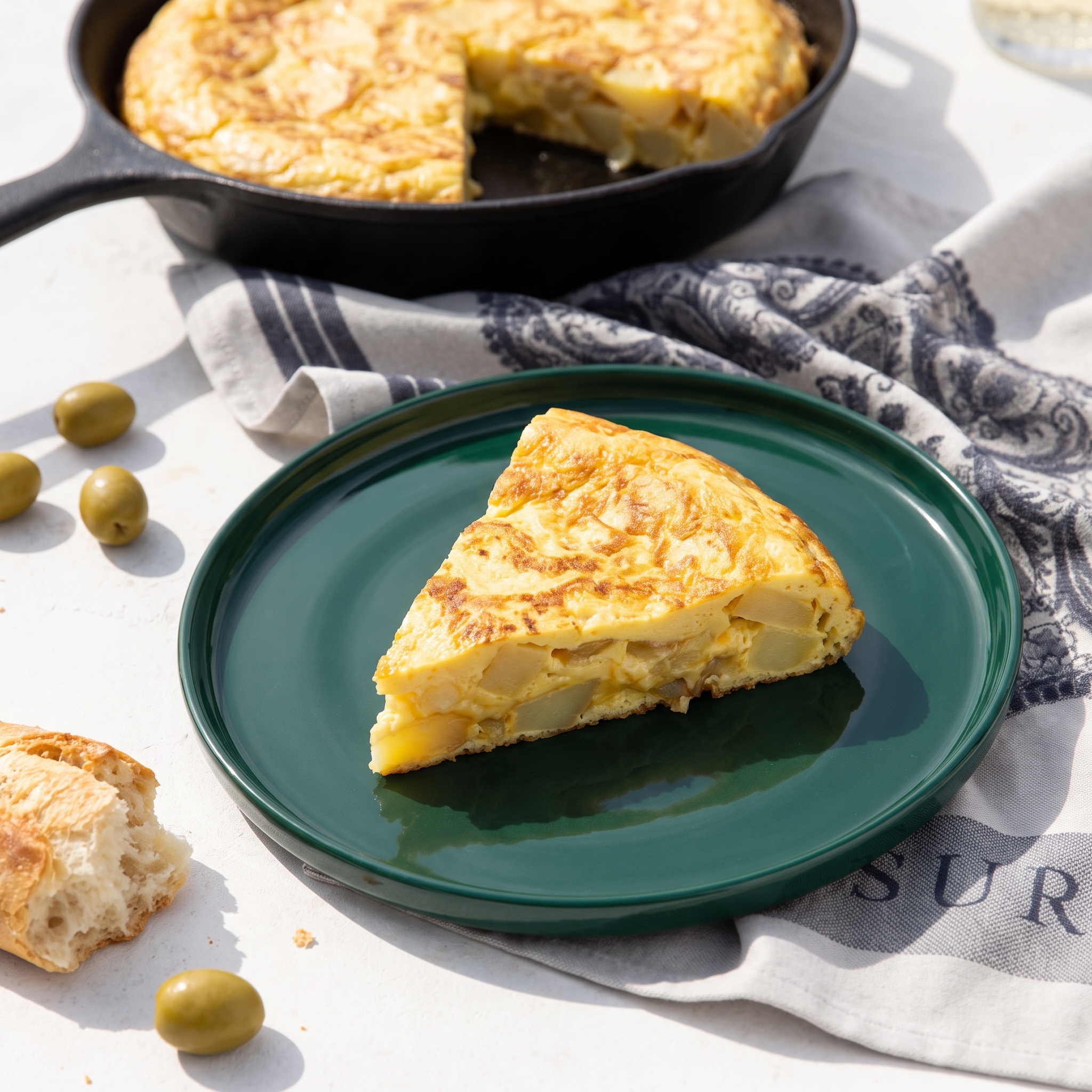
Spanish Olive Oil Tortilla
Ingredients
Method
- Heat the Wilson’s Extra Virgin Olive Oil in a deep frying pan over low heat until it reaches a gentle simmer.
- Add the sliced potatoes and onion, season with salt, and poach gently for 25-30 minutes, stirring occasionally, until the potatoes are completely soft but not browned.
- Drain the potatoes and onion in a colander set over a bowl, reserving the oil. Set the potatoes aside to cool slightly.
- Beat the eggs in a large bowl with a pinch of salt. Fold in the warm potatoes and onion and let the mixture rest for 5 minutes.
- Return 2-3 tablespoons of the reserved oil to the pan over medium-low heat. Pour in the egg and potato mixture, spreading it evenly, and cook for 3-4 minutes until the edges set.
- Cover the pan with a plate, flip the tortilla onto the plate, then slide it back into the pan to cook the other side for 2-3 minutes.
- Slide onto a plate and rest for at least 10 minutes before slicing into wedges.
Notes
We Use Extra Virgin Olive Oil
The oil in this dish is doing confit work, not frying. Wilson’s Extra Virgin Olive Oil sits at a bare simmer while the potato and onion go in, nowhere close to a proper fry, and they stay there for the better part of half an hour.
At that low, steady heat the oil never gets hot enough to brown or crisp anything. It just works its way slowly into the potato instead, which is exactly what turns raw slices soft enough to fold into beaten egg without breaking apart.
A spoonful or two of that same oil goes back into the pan before the egg does, so the flavour that built up over the poach carries straight through to the finished tortilla.
Our Tips
Cut the potato slices to roughly the same thickness. Even slices poach at the same rate, so you won’t end up with a mix of soft and firm pieces.
Watch for small, lazy bubbles, not a sizzle. That’s the sign the oil is at a true poaching temperature rather than frying.
Season while the potatoes are still in the oil. Salting early gives it time to actually reach the inside of each slice.
Don’t skip the rest before cooking the egg. A few minutes lets the warm potato soak into the beaten egg, which helps the tortilla hold together once it’s in the pan.
Use a plate a size bigger than the pan to flip it. It gives you something to press firmly against the rim before turning the whole thing over in one motion.
Pull it off the heat a touch early for a softer centre. A shorter second side keeps the middle closer to how it’s often served in Spain.
How We Serve It
A tortilla belongs at room temperature, not fresh off the stove. Giving it a proper rest lets the centre finish setting so it holds its shape when you cut into it.
Cut small, it’s a tapa alongside olives and a sharp cheese. Cut into bigger wedges, it’s substantial enough to anchor a weekend brunch table on its own.
A simple tomato salad on the side does the same job a glass of chilled sherry would in Spain — something sharp to cut through all that egg and potato.
More Ways to Use Extra Virgin Olive Oil
A bottle of Wilson’s Extra Virgin Olive Oil earns its keep well past a pan of poached potatoes.
For bread to go alongside — it’s worked straight into the dough in our Homemade Roosterkoek.
For a hearty pasta salad — it builds the chimichurri dressing in our Summer Solstice Salad.
For a simple pan-seared chop — it’s in the marinade and the pan in our Greek Lamb Chops.
For something off the coals — it marinates the lamb and builds the salsa in our Turkish Kebabs with Tomato and Olive Salsa.
The Good Stuff About Extra Virgin Olive Oil
Extra virgin sits at the top of the olive oil grading system, pressed mechanically without heat or chemical solvents and held to a strict acidity ceiling. In a dish where the oil does this much of the actual cooking, that quality comes through directly in the finished tortilla instead of hiding behind other flavours.
250ml – 5L
Bottle Sizes
6x250ml / 6x1L
Case Options
Halaal & Kosher
Certified
2 Years
Shelf Life
Ways to Change It Up
Leave the onion out entirely. Some Spanish kitchens swear by potato alone — a starker flavour without losing any of the texture.
Fold in roasted red peppers. Sliced thin through the egg mixture, they bring colour and a little sweetness.
Brown some chorizo and stir it through. It turns a simple tortilla into a more substantial plate.
Swap in sweet potato for half the regular potato. A sweeter, softer bite without changing the method at all.
Add a pinch of smoked paprika to the egg. A small, Spanish-pantry touch that deepens both the colour and the flavour.
Leave the centre slightly underset. A shorter second side gives a softer, almost custardy middle, closer to how it’s often served in Spain.
Spanish Olive Oil Tortilla Questions
Does onion always go into a Spanish olive oil tortilla?
Most versions include it, ours among them. Add it with the potatoes so it softens fully in the same gentle poach rather than staying raw or browning on its own.
What’s the easiest way to flip it without making a mess?
Cover the pan with a plate a little wider than the pan, press it firmly against the rim, then flip the pan and plate together in one confident motion.
Can I use fewer eggs to make it lighter?
You can drop to five eggs for a slightly lighter tortilla, though six is what gives it that classic thick, custardy centre.
Is it better warm or at room temperature?
Room temperature is the traditional way. Resting it for at least 20 minutes after cooking lets the centre finish setting properly.
How long will it keep in the fridge?
Covered, it holds for up to three days. Bring it back to room temperature rather than reheating it, which can dry out the egg.
Does the type of potato matter?
A waxy or all-purpose potato holds its shape better through the long poach than a very starchy one, which can break down too much.
Where can I buy Wilson’s Extra Virgin Olive Oil?
It’s available to order directly from oliveoil.co.za and at leading retailers across South Africa.
Ready to Make This?
Get the oil that quietly poaches every slice before the egg even shows up.
More From Our Kitchen
Homemade Roosterkoek — Summer Solstice Salad — Greek Lamb Chops — All Recipes
Made this? We’d love to see
Tag us @theoilpeopleza · #WilsonsFoods