
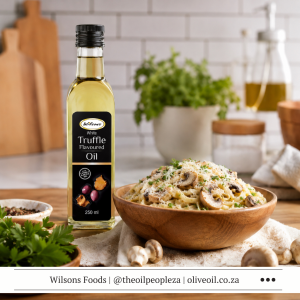
Umbria is a landlocked region in central Italy — no coastline, no famous city, not a lot of tourism. What it has is truffles, porcini mushrooms, and a way of cooking pasta that treats both with complete seriousness. The pasta is handmade and torn rather than cut — rough, irregular pieces that hold sauce in ways that perfect fettuccine never quite manages. The mushrooms go in with garlic, thyme and two anchovy fillets that dissolve completely into the oil and become the background seasoning for everything else.
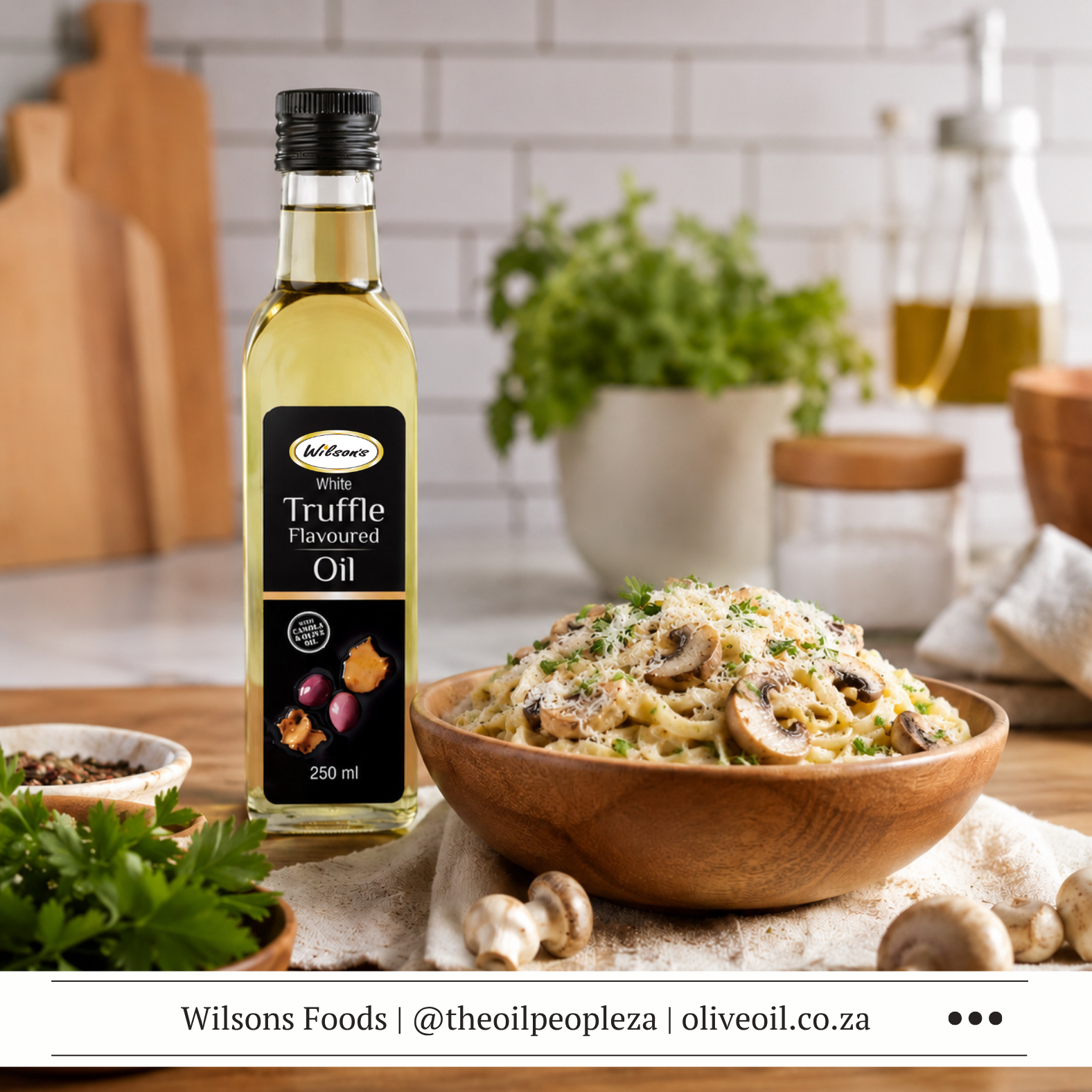
The truffle comes at the very end. Wilson’s Foods White Truffle Flavoured Oil gets drizzled over each bowl just before it reaches the table — never into the pan, never onto heat. Truffle is volatile. The aroma disappears the moment it meets anything above room temperature. That final drizzle is what makes the dish, and it only works if you add it cold, at the last possible moment.
This is a Saturday evening pasta. Not a quick weeknight bowl — the dough needs thirty minutes to rest, the mushrooms need time to properly colour. But it’s also not complicated. An hour from start to table, and the kind of result that makes that hour feel very well spent.
Mushroom & Truffle Pasta
Ingredients
Method
- Make the pasta dough. Tip the flour onto a clean work surface and make a well in the centre. Crack the eggs into the well, add a pinch of salt, and use a fork to gradually beat the eggs into the flour, working from the inside out. Once a rough dough forms, knead with your hands for 8–10 minutes until smooth and elastic. Wrap in cling film and rest for 30 minutes at room temperature.
- Roll the pasta. On a lightly floured surface, roll the dough out to about 2mm thickness. Tear or cut into rough irregular pieces — this is umbricelli style, no need to be precise. The unevenness is part of the charm.
- Cook the pasta. Bring a large pot of salted water to the boil.
- Make the sauce. Heat a generous splash of olive oil in a wide pan over medium heat. Add the anchovy fillets and let them melt into the oil — they will dissolve completely and become the seasoning base. Add the garlic and thyme and cook for 1–2 minutes until fragrant. Add the mushrooms and cook for 6–8 minutes until golden and tender. Season with black pepper — taste before adding salt as the anchovies are already salty.
- Cook the pasta in the boiling salted water for 2–3 minutes until al dente. Reserve a cup of the starchy cooking water before draining.
- Add the butter to the mushroom pan and let it melt. Add the drained pasta and a splash of cooking water and toss everything together until the pasta is coated and glossy. Add more cooking water if needed to loosen the sauce.
- Divide between two warm bowls. Grate over the Grana Padano and finish with a generous drizzle of Wilson's Foods White Truffle Flavoured Oil. Serve immediately.
Notes
We Use Wilson’s Foods White Truffle Flavoured Oil
Wilson’s Foods White Truffle Flavoured Oil is a finishing oil — it goes on at the end, cold, just before the bowl reaches the table. This is not a preference, it’s a requirement. Truffle aroma is carried by volatile compounds that evaporate rapidly above around 60°C. Cook with it and you lose the entire point of using it. Drizzle it over a finished dish and the aroma stays intact, rising from the bowl in a way that makes the first bite genuinely arresting.
In this dish it does something specific — it ties the earthiness of the porcini, the richness of the butter and the depth of the anchovy base into something that tastes far more considered than the ingredient list suggests. White truffle has a cleaner, more delicate character than black truffle, which makes it a better match for a pasta this simple. There’s nothing to hide behind here, and the oil doesn’t need to hide.
A little goes a long way. Half a teaspoon per bowl is usually enough. The temptation is to pour generously — resist it. Truffle is one of those flavours where more is quickly too much. Start with less and add another drop at the table if you want.
A Few Tips
Don’t skip the anchovy — two fillets dissolve completely into the oil and leave no fishiness behind. What they leave is depth, saltiness and a savoury quality that makes the mushrooms taste more like themselves. Anyone who says they don’t like anchovies won’t know they’re in there.
Get the mushrooms properly golden — don’t rush this step and don’t crowd the pan. Mushrooms release a lot of moisture. If the pan is too full they steam instead of fry and the colour never develops. Colour is flavour. Give them time and space.
Save more pasta water than you think you need — the starchy cooking water is what makes the sauce cling to the pasta and become glossy rather than greasy. Reserve a full cup before you drain and keep it nearby. A splash at a time loosens everything without watering it down.
Serve in warm bowls — pasta cools quickly and truffle oil aroma is even more temperature-sensitive than most. Run hot water into your bowls while the pasta finishes, then dry them just before serving. It makes a real difference to both the eating temperature and the aroma.
The truffle oil goes on last — after plating, after the cheese, right before the bowl reaches the table. Never into the hot pan, never into the sauce. Half a teaspoon per bowl is enough — it’s a drizzle, not a pour.
If you can’t find fresh porcini — soak 10g of dried porcini in 100ml of hot water for 15 minutes. Drain and add to the pan with the chestnut mushrooms. Strain the soaking liquid through a fine sieve and add it to the pan in place of some of the pasta water. The dried porcini give the sauce considerably more depth than fresh ones in many cases.
How We Serve It
Straight from the pan into warm bowls. The cheese goes on first — a light snow of finely grated Grana Padano over the pasta — and then the truffle oil, drizzled in a thin line across the top of each bowl just before serving. The aroma hits the moment the oil makes contact with the warm pasta beneath it.
This is a two-course meal. Nothing more than a simple green salad alongside — rocket with a little lemon and olive oil is the obvious call, and it cuts through the richness of the butter and truffle in the right way. A glass of something Italian is worth the effort. Vermentino from Sardinia, or a light Umbrian red if you can find one.
Keep the truffle oil on the table. People will want more. Let them add it themselves — a drop or two is the right amount and everyone’s threshold is slightly different.
More Ways to Use Wilson’s Foods White Truffle Flavoured Oil
Wilson’s Foods White Truffle Flavoured Oil works wherever you want the truffle character to arrive clean and undiluted. A few places worth trying:
Braai Potato Salad — a drizzle of truffle oil over a warm potato salad with fresh herbs takes it somewhere considerably more interesting than the standard braai table version. Get the recipe.
Scrambled eggs — a few drops of truffle oil over creamy scrambled eggs just before serving. One of the simplest and most effective uses of the oil, and a very good reason to make eggs for dinner.
Risotto — truffle oil drizzled over a finished mushroom risotto is the classic application for a reason. Stir it in at the very end, off the heat, just before serving.
Pizza — a thin drizzle of truffle oil over a mushroom or potato pizza straight from the oven. The heat of the pizza releases the aroma without cooking off the flavour.
Popcorn — drizzle over freshly popped popcorn with a pinch of flaky salt and finely grated Parmesan. It sounds unusual. It disappears faster than anything else in the bowl.
The Good Stuff
Wilson’s Foods White Truffle Flavoured Oil is a finishing oil with a low smoke point — around 160°C — which is why it should never be used as a cooking oil. The flavour compounds that make truffle distinctive are highly volatile and disappear quickly at high temperatures. Store it in a cool, dark place, sealed tightly after each use, and use it within a reasonable time of opening. Truffle oil fades as it oxidises.
Worth being clear about what truffle oil is and isn’t — most truffle oils, including flavoured truffle oils, use a synthetic aroma compound called 2,4-dithiapentane to recreate the truffle character. This is standard practice across the industry and is the reason truffle oil is accessible at a price point that makes everyday use possible. The flavour it delivers is genuine and delicious in the right application, even if the source is different to a fresh truffle shaved tableside. Wilson’s Foods White Truffle Flavoured Oil is vegan, dairy-free, and contains no artificial colourants.
Ways to Change It Up
Use dried pasta — a good quality dried tagliatelle, pappardelle or spaghetti works well if you don’t want to make fresh pasta. Cook it two minutes short of the packet instructions and finish it in the sauce pan with the pasta water.
Make it vegetarian — leave out the anchovy and add an extra pinch of sea salt. The depth is slightly different but the dish still works. A small spoon of white miso stirred into the butter is a good alternative if you want to replace the umami the anchovy provides.
Add cream — stir two tablespoons of cream into the mushrooms before the pasta goes in for a richer, more indulgent sauce. The truffle oil over the top still works — the cream gives it something to rest against.
Change the mushrooms — shiitake, oyster, portobello and chestnut all work well in this dish. A mix of two or three varieties gives more complexity than a single type. The key is getting each type properly golden before adding the next.
Add a soft egg — a soft-boiled or poached egg on top of the finished pasta, with the yolk broken over the noodles just before eating. The yolk acts as an extra sauce and works beautifully with the truffle oil.
Scale it up — this recipe doubles easily for four people. Make the pasta dough in one batch and keep it covered while you prepare the sauce. The cooking time stays the same — just use a wider pan.
Questions You Might Have
Can I cook with truffle oil?
No — not if you want to taste it. The aroma compounds in truffle oil are volatile and disappear almost immediately at cooking temperatures. Use it as a finishing oil only — drizzled over a completed dish just before serving. Never into a hot pan, never into a sauce on the stove.
Can I make the pasta dough ahead of time?
Yes — the dough can be made and wrapped tightly in cling film up to 24 hours ahead and kept in the fridge. Bring it back to room temperature for 20 minutes before rolling. You can also roll and cut it, dust with flour to prevent sticking, and refrigerate on a tray for a few hours before cooking.
I can’t find fresh porcini — what should I use?
A mix of chestnut and portobello mushrooms with 10g of dried porcini soaked in hot water gives you the closest result. Strain the soaking liquid and use it in the sauce — it carries a lot of the porcini flavour. Woolworths and most good delis stock dried porcini year-round.
Won’t the anchovy make it taste fishy?
No — anchovies dissolved in hot oil lose all their fishiness and leave only depth, saltiness and umami. It’s the same reason anchovies go into so many Italian pasta sauces. Anyone who tries this dish without knowing will not identify anchovy as an ingredient.
How much truffle oil should I use?
Start with half a teaspoon per bowl. Truffle flavour builds quickly and more is very easily too much. It’s much easier to add a drop more at the table than to deal with a bowl that tastes overwhelmingly of truffle. Keep the bottle on the table and let people adjust.
How should I store truffle oil?
In a cool, dark place, sealed tightly after every use. Truffle oil oxidises and fades over time — use it within a reasonable time of opening. Some people keep it in the fridge, which is fine and slows oxidation, though it may go cloudy when cold. It clears again at room temperature.
Where can I buy Wilson’s Foods White Truffle Flavoured Oil?
Wilson’s Foods White Truffle Flavoured Oil is available online at oliveoil.co.za and at leading retailers across South Africa.
Make Saturday Feel Like Somewhere in Italy.
Wilson’s Foods White Truffle Flavoured Oil is available online and at leading retailers across South Africa.
Shop Now More RecipesMore From Our Kitchen
Braai Potato Salad with White Truffle Oil — Chilli & Garlic Prawns — Cheesy Onion Soup — Roasted Tomato Soup with Basil Oil — All Recipes
Made this? We’d love to see.
Tag us @theoilpeopleza · #WilsonsFoods