
Jan van Riebeeck planted the first olive trees at the Cape in 1661. He wasn’t thinking about supermarkets or wellness trends. He was planting food. Three and a half centuries later, those trees are gone but the tradition they started is very much alive — and the Western Cape has quietly become one of the most respected olive oil producing regions on the planet.
Most people buy olive oil the way they buy table salt — it’s just there. But when you start to understand what goes into a bottle of cold pressed extra virgin olive oil, the price tag makes a lot more sense, and you start treating it very differently in the kitchen.
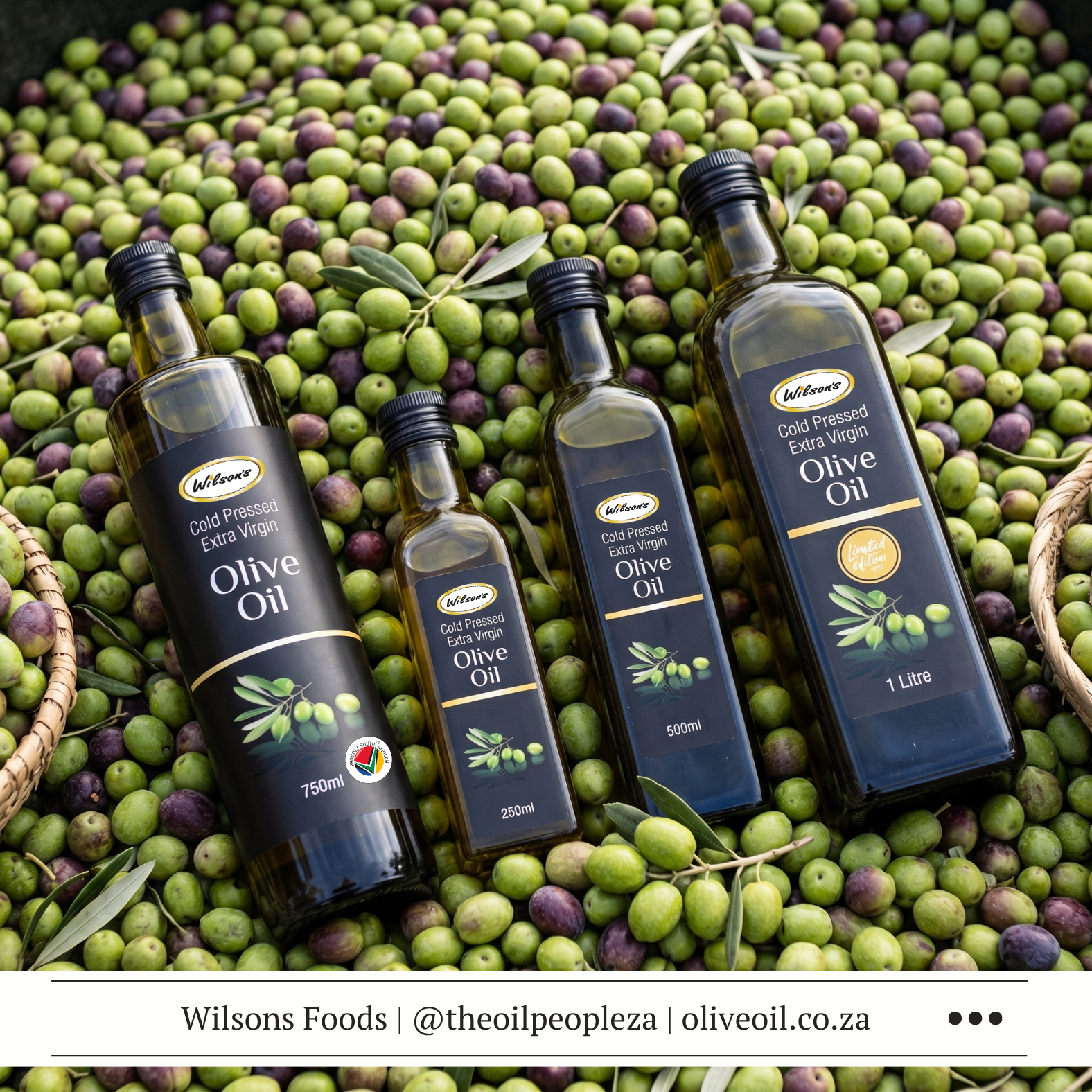
This is the story of Wilson’s Extra Virgin Cold Pressed Olive Oil — and the fruit, the trees, and the process that go into every bottle.
A Tree That Outlives Everyone
The olive tree is one of the oldest cultivated trees in human history. There are verified specimens in the Mediterranean that are over a thousand years old and still producing fruit. The most famous — the Vouves olive tree in Crete — is estimated to be somewhere between 2,000 and 4,000 years old. It still bears fruit every season.
A young tree starts bearing fruit at around five to seven years old, but peak production only hits around the fifty-year mark. Most productive trees carry between twenty and fifty kilograms of olives per season. That sounds like a lot until you understand what it takes to turn those olives into oil.
Olive trees are also alternate producers — a heavy harvest one year is typically followed by a lighter one the next. It’s not a machine. It’s a living tree with a rhythm of its own.
The Numbers Behind Your Bottle
Standard olive oil — 4 to 5 kg of olives per litre. That’s the general rule for commercially produced olive oil. At around 200 olives per kilogram, you’re looking at roughly 800 to 1,000 olives to fill a single litre bottle.
Cold pressed extra virgin — up to 8 to 10 kg per litre. Premium EVOO demands far more fruit. Early-harvest olives — picked before peak ripeness for maximum flavour and polyphenol content — yield less oil per kilogram. Which means a litre of quality cold pressed EVOO can represent up to 2,000 individual olives. Hand-picked.
One tree. One season. Three to four litres of oil. At a standard yield, a single mature olive tree produces enough olives for roughly three to four litres of oil in a good season. For premium cold pressed EVOO, that number drops to two to three litres per tree.
One tablespoon of EVOO — about eighty olives. Next time you drizzle it over a salad, that’s worth knowing.
What Cold Pressed Actually Means
Cold pressing means the olives are crushed and pressed at temperatures below 27°C, without the use of heat or chemicals. Heat makes extraction faster and cheaper. It also destroys a significant portion of the polyphenols, antioxidants, and flavour compounds that make EVOO worth buying in the first place.
Extra virgin is the highest grade of olive oil. To qualify, the oil must be produced by mechanical means only, with no chemical treatment, and the free acidity must be below 0.8%. It must also pass a sensory evaluation — a trained panel assessing aroma and flavour. Oil that fails on either count gets downgraded.
Most of what lines supermarket shelves globally is not extra virgin, regardless of what the label suggests. Which is why what’s in the bottle matters as much as the words on it.
South Africa’s Quiet Olive Revolution
Here’s something most South Africans don’t know: approximately 95% of all olive oil produced locally is extra virgin. In much of Europe, that figure is a fraction of total production. South Africa entered the industry late, bypassed the industrial era, and built its production around third-generation cold press technology from the start.
The Western Cape accounts for around 93% of local production, with the Paarl, Robertson and Montagu areas particularly well suited to the Mediterranean-style climate olives need. Land under olive cultivation has more than doubled in the past decade — from under 1,800 hectares in 2008 to over 3,700 hectares today. The industry is still small by global standards — South Africa produces around 1.6 million litres per year, less than 1% of world output — but the quality is world-class. In 2025, a South African estate was ranked 24th in the global EVOO rankings, the highest ever placement for a South African producer.
Per capita consumption in South Africa sits at just 80ml per person per year. In Greece, it’s around 20 litres. That gap tells you everything about the opportunity in front of the local industry — and how much headroom there is to grow. The SA Olive Association has been driving quality standards and consumer education since 2004, and their Commitment to Compliance (CTC) seal is the mark to look for on locally produced oil.
The Good Stuff
The health case for extra virgin olive oil isn’t trend-driven. It’s decades of research, much of it centred on the Mediterranean diet and why populations that consume large amounts of EVOO consistently show lower rates of cardiovascular disease, inflammation, and cognitive decline.
The key compounds in cold pressed EVOO are oleic acid, polyphenols, and a particularly interesting one called oleocanthal. Oleic acid makes up around 73% of the fat in EVOO — a monounsaturated fat that lowers LDL (bad) cholesterol while maintaining HDL (good) cholesterol. Polyphenols including hydroxytyrosol are among the most potent natural antioxidants known, protecting cells against oxidative stress and supporting gut health and arterial function.
Oleocanthal is the one that tends to stop people mid-sentence. Research confirmed in 2005 at the University of Pennsylvania found that oleocanthal inhibits the same inflammatory enzymes — COX-1 and COX-2 — targeted by ibuprofen. If you’ve ever felt a peppery sting at the back of your throat tasting a good EVOO, that’s it. That sensation is the oleocanthal. It’s not a flaw — it’s the sign of a high-quality oil.
These compounds are only present in meaningful quantities in cold pressed extra virgin olive oil. Heat-extracted and refined oils don’t carry them. Which is why the grade of oil you buy matters far more than most people realise.
How We Use It
Cold pressed EVOO is stable enough to cook with at home temperatures — sautéing, roasting, baking — and the smoke point is well within the range of everyday cooking. The myth that you can’t cook with good olive oil is just that. A myth.
Where it really earns its place is anywhere it doesn’t get cooked at all — finishing dishes, dressing salads, dipping bread, drizzling over soup or roasted vegetables just before they come to the table. That’s when the flavour and the polyphenols are fully intact.
One thing to keep in mind: olive oil doesn’t improve with age. Unlike wine, it doesn’t benefit from sitting in the bottle. Buy it fresh, store it in a cool dark place, and use it within twelve to eighteen months of the harvest date.
Ready to Make This?
Wilson’s Extra Virgin Cold Pressed Olive Oil is available online and at leading retailers across South Africa.
More From Our Kitchen
Pickled Fish — Cape Malay Chicken Biryani — Pad Thai — Chilli & Garlic Prawns — All Recipes
Did you know the peppery sting at the back of your throat is a sign of quality? Tell us what you use your EVOO for most in the comments.
Tag us @theoilpeopleza · #WilsonsFoods
1 thought on “What Is Extra Virgin Olive Oil?”
Hi. I’m very interested in your oil & hope it’s nothing like the supermarket suppliers or the Greek deli oils