
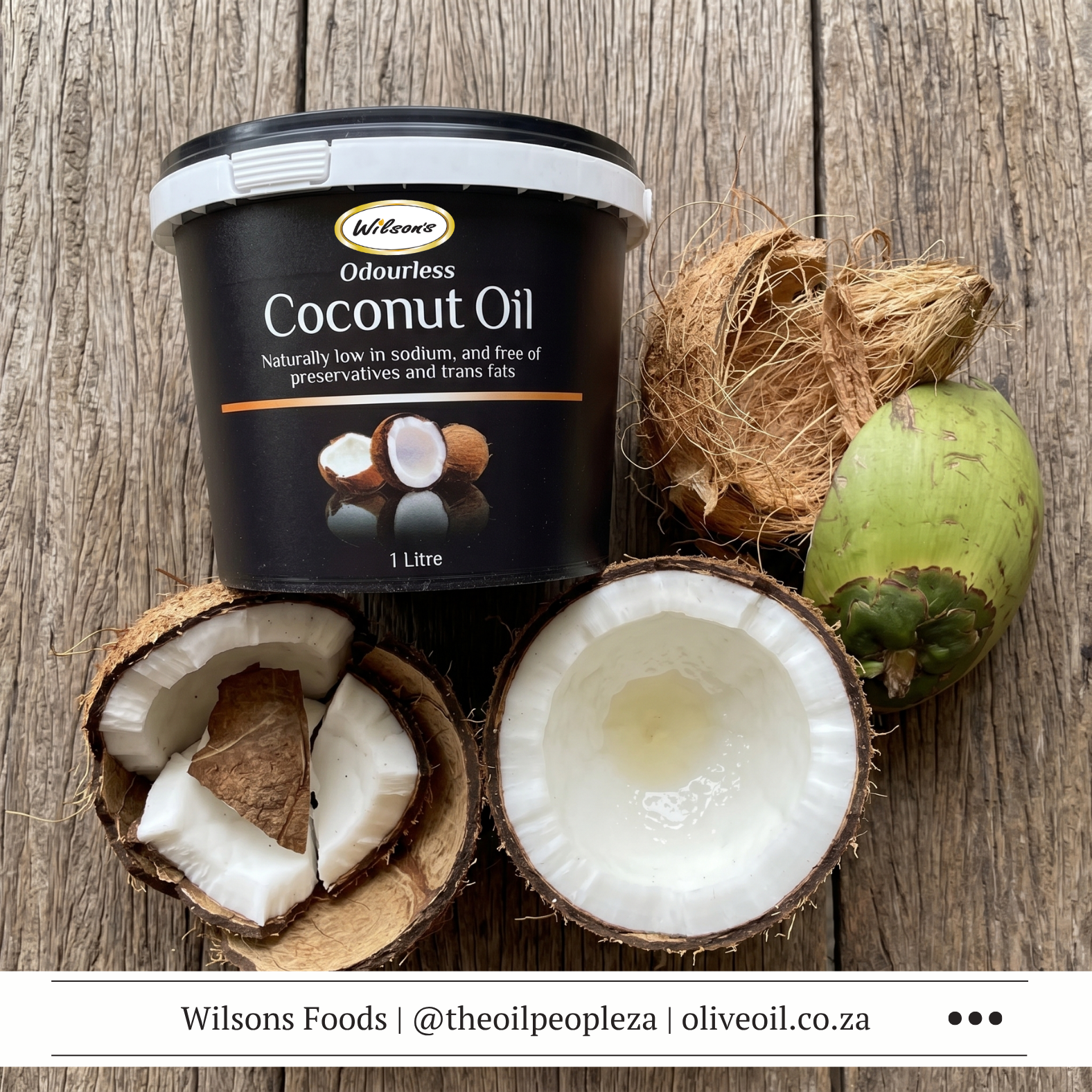
The jar lives in the back of the baking cupboard. White and solid, faintly sweet-smelling, a little mysterious. You bought it for a recipe that called for exactly two tablespoons, used it, and then left it there — next to the baking powder and the vanilla you keep forgetting to replace. Sound familiar?
Coconut oil has spent the last decade cycling through every possible reputation: miracle superfood, dangerous saturated fat, skin-care essential, keto staple, bakery secret. Coconut oil is a genuinely versatile fat with a clear set of strengths, a few real limitations, and a specific place in a well-stocked kitchen. Once you understand what it actually is and what it does well, it stops being mysterious and starts being useful.
Here is everything you need to know.
What is coconut oil, exactly?
Coconut oil is pressed from the dried meat — called copra — of the mature coconut. The coconut palm (Cocos nucifera) grows across the tropics, and the oil it produces is unlike most other plant-based fats. Where oils like canola, sunflower, or olive are predominantly unsaturated, coconut oil is roughly 90% saturated fat. That single chemical fact explains almost everything distinctive about it: why it is solid at room temperature, why it is so stable under heat, why it has such a long shelf life, and why the health debate around it has been so lively.
The saturated fats in coconut oil are not all the same. The dominant fatty acid is lauric acid, which makes up close to half of the total fat content. Lauric acid is classified as a medium-chain fatty acid (though it behaves metabolically more like a long-chain fat — more on that below). Alongside it sit caprylic acid and capric acid, both genuinely medium-chain, and both absorbed quickly by the body. This fatty acid profile is the basis of most of coconut oil’s claimed health properties, and also the source of most of the scientific debate.
Refined vs. virgin coconut oil — which one are you buying?
Walk into any supermarket and you will see both, sometimes on the same shelf. It comes down to how the oil was processed.
Virgin coconut oil is pressed directly from fresh coconut meat using a wet or dry method. It retains the natural coconut aroma and flavour, and it has a lower smoke point — around 175–180°C. It is the more expensive of the two and is preferred when you want that unmistakable coconut character in your finished dish.
Refined coconut oil — sometimes labelled RBD (Refined, Bleached, Deodorised) — goes through additional processing that removes the coconut scent and flavour almost entirely. The result is a neutral-tasting fat with a higher smoke point, typically around 200–230°C, depending on the refining method. It is the more practical everyday cooking option, and the more affordable one.
Wilson’s Coconut Oil is refined. A neutral coconut oil works in far more applications than a scented one. You can use it in baking without every muffin tasting like the beach, and it handles the heat of a sauté or a quick fry without fuss. For dishes where you specifically want that tropical note — a Thai curry, a coconut rice, a stir-fry — Wilson’s Coconut Flavoured Oil is the better call. Same stability, but with the fragrance dialled up.
If you want to go deeper on how coconut oil is actually processed, Wilson’s has a plain-language breakdown in the Processing Coconut Oil article — worth reading before you form a strong opinion about “organic” vs. “regular.”
Cooking with coconut oil — what it does well
Coconut oil’s high saturation makes it one of the more heat-stable plant-based fats available. Unlike polyunsaturated oils — which oxidise readily under heat and can produce harmful compounds if pushed too hard — coconut oil holds its structure. For everyday home cooking, that matters.
Baking. This is where coconut oil earns its place most reliably. In its solid state it behaves similarly to butter — you can cream it, rub it into flour, or melt it into a batter. It produces a tender, moist crumb and a clean finish. The vegan baking community figured this out early: coconut oil is one of the most effective butter substitutes in plant-based recipes. Try it in the Vegan Chocolate Coconut Cake on the site — the oil gives the cake structure and keeps it from drying out, even without eggs or dairy.
Sautéing and stir-frying. At medium-high heat, refined coconut oil performs reliably. It does not smoke at the temperatures most home cooks use, and it leaves no flavour footprint in neutral dishes. For anything with strong aromatics — garlic, ginger, chilli — it is a useful base oil that gets out of the way and lets the flavours do the work.
Crust and pastry. Because it is solid at room temperature, coconut oil can replace lard or butter in pastry with some success. The fat coats the flour properly and creates the layered structure you are looking for. The Baked Date Cheesecake recipe uses coconut oil in the crust — oat flour, dates, and melted coconut oil — and it holds together beautifully.
Thai and Southeast Asian cooking. This is the natural home of coconut in general, and where Wilson’s Coconut Flavoured Oil earns its name. Curries, satay sauces, noodle dishes, coconut rice — when you want that aromatic warmth to be part of the dish, reach for the flavoured oil. The Spicy Thai Peanut Chicken on the site shows how well it works alongside peanut butter and coconut milk.
Smoothies and no-bake treats. A tablespoon of coconut oil in a smoothie adds body and a slight richness. In no-bake bars, truffles, and energy balls — where you need a fat that solidifies in the fridge to hold everything together — coconut oil is the standard choice. It sets cleanly, releases easily from moulds, and does not leave a greasy coating.
Where coconut oil falls short
It is worth being honest about this. Coconut oil is not a universal cooking fat, and knowing its limits is as useful as knowing its strengths.
Its smoke point, while adequate for most home cooking tasks, is lower than peanut oil, grapeseed oil, or high-oleic sunflower oil. If you are deep-frying at temperatures above 200°C and doing so repeatedly, those oils will give you more control and less degradation. For high-heat frying, coconut oil is usable but not ideal.
In salad dressings, coconut oil is a poor choice. It solidifies below about 25°C, which means a dressing made with it will seize up the moment it hits a cold bowl of leaves. For dressings, finishing drizzles, or any application where you want the oil to remain liquid and flow, extra virgin olive oil or grapeseed oil will serve you better.
And for everyday high-volume cooking — the pan you use for scrambled eggs, pasta sauce, and weeknight dinners — there are more cost-effective and nutritionally balanced options. Olive blends cover those bases without asking you to think about whether the fat is liquid or solid.
The health picture — what the science actually says
Coconut oil became a wellness phenomenon in the 2010s, and with that came claims that outran the evidence. The MCT story is real but frequently misapplied: genuine medium-chain triglycerides — caprylic and capric acid — are metabolised quickly and may support energy and satiety. Coconut oil does contain these. But the dominant fat in coconut oil is lauric acid, which, despite being classified as an MCT, is absorbed and metabolised more like a long-chain fatty acid. The health research conducted on purified MCT oils does not translate directly to commercial coconut oil.
On cholesterol, the picture is mixed. Coconut oil does raise LDL (the so-called bad cholesterol) more than most unsaturated oils. It also raises HDL (the good cholesterol) to a greater degree than many other saturated fats. Researchers at Harvard’s nutrition school have noted that populations in India, the Philippines, and Polynesia who consume significant amounts of coconut show low rates of cardiovascular disease — but they also note that many other dietary and lifestyle factors are at play. The Harvard T.H. Chan School of Public Health has a balanced, evidence-led overview if you want to read the details.
Lauric acid does appear to have genuine antimicrobial properties. When converted to monolaurin in the body, it demonstrates activity against certain bacteria, viruses, and fungi. This is likely why coconut oil has a long tradition of topical and therapeutic use across tropical cultures, and why it remains popular as a skin and hair treatment.
Coconut oil is a fine cooking fat used in appropriate quantities, alongside a varied diet. It is not a health food in the supplemental sense, and it should not replace more nutritionally diverse fats across the board. But it is not the dietary villain some headlines made it out to be either. Use it for what it does well. Understand what it is. And read the full comparison of coconut oil and olive oil on the site if you want to think about how they sit alongside each other.
Beyond the kitchen
Coconut oil has been used as a skin and hair treatment for centuries across South and Southeast Asia, and there is good reason for it. The lauric acid content gives it gentle antimicrobial properties, and the fat itself is an effective emollient — it absorbs reasonably well, leaves skin soft, and does not contain synthetic additives when you choose a food-grade product. Applied to hair, it reduces protein loss in damaged strands and conditions the scalp.
If you are using food-grade coconut oil topically, refined is fine. It has no scent and no colour, and it is just as moisturising. A jar of Wilson’s Coconut Oil will work in the bathroom as effectively as it does in the kitchen — which is part of what makes it a useful thing to have in the house.
How to store coconut oil
Coconut oil keeps well because it is so highly saturated — saturated fats resist oxidation, which is what causes cooking oils to go rancid. Store it in a cool, dark place, away from direct sunlight and heat sources. It does not need refrigeration, though refrigerating it is harmless — it will just be harder to scoop.
The solid-to-liquid transition happens at around 24–25°C. In a Cape Town summer it will be liquid in the jar; in a Joburg winter it will be firm. Neither state is better than the other — the oil has not degraded, it has simply changed phase. If you need it liquid for a recipe and it is solid, sit the jar in a bowl of warm water for a few minutes.
A few tips
Measure coconut oil by weight when you can, not volume. Because it changes state between liquid and solid depending on your kitchen temperature, a tablespoon measured as a solid and a tablespoon measured as a liquid are not quite the same thing. For baking especially, using a scale removes the guesswork.
If a recipe asks for coconut oil and you only have olive oil — or the reverse — you can substitute in most baking and sautéing applications at a 1:1 ratio by weight. The flavour will differ slightly and the texture of baked goods may be marginally different, but it works. The more important thing is to understand what each oil does well, so you can make the call yourself. Wilson’s full range is at oliveoil.co.za/shop — including both the neutral refined coconut oil and the flavoured version, if you want to have both in the cupboard.
Ready to cook with coconut oil?
Try it in the kitchen with a few of these recipes:
→ Vegan Chocolate Coconut Cake
Shop Online @ https://www.oliveoil.co.za/shop/kitchen-pantry/coconut-oil/