
Friday night, a whole fish on the counter, and the kind of paste that fills the kitchen with lemongrass before you’ve even switched the oven on. We’ve made this one a few times now — the recipe came from Jamie Oliver’s Friday Night Feast, which is exactly the register it belongs in. It’s not a Tuesday night thing. It’s the fish you make when there’s time to pound a paste, wrap something in a banana leaf, and eat with people who’ll stay late.
The paste is ginger, lemongrass, red chilli, shallot, kaffir lime leaves and toasted peanuts — pounded together and rubbed all over the fish, inside and out. Wilson’s Ginger Flavoured Lime Juice goes into the paste and into the coconut rice — it runs a citrus thread through the whole dish without competing with anything. The ginger note ties back to the fresh ginger in the paste. The lime keeps both the fish and the rice from going flat.
The fresh fish counter at Woolworths usually has whole sea bass — ask them to scale and gut it if it isn’t done already. The recipe also comes with coconut rice, a quick chilli pickle and a shredded rainbow salad that goes together while the fish is in the oven. It’s a full spread. Worth every minute of it.
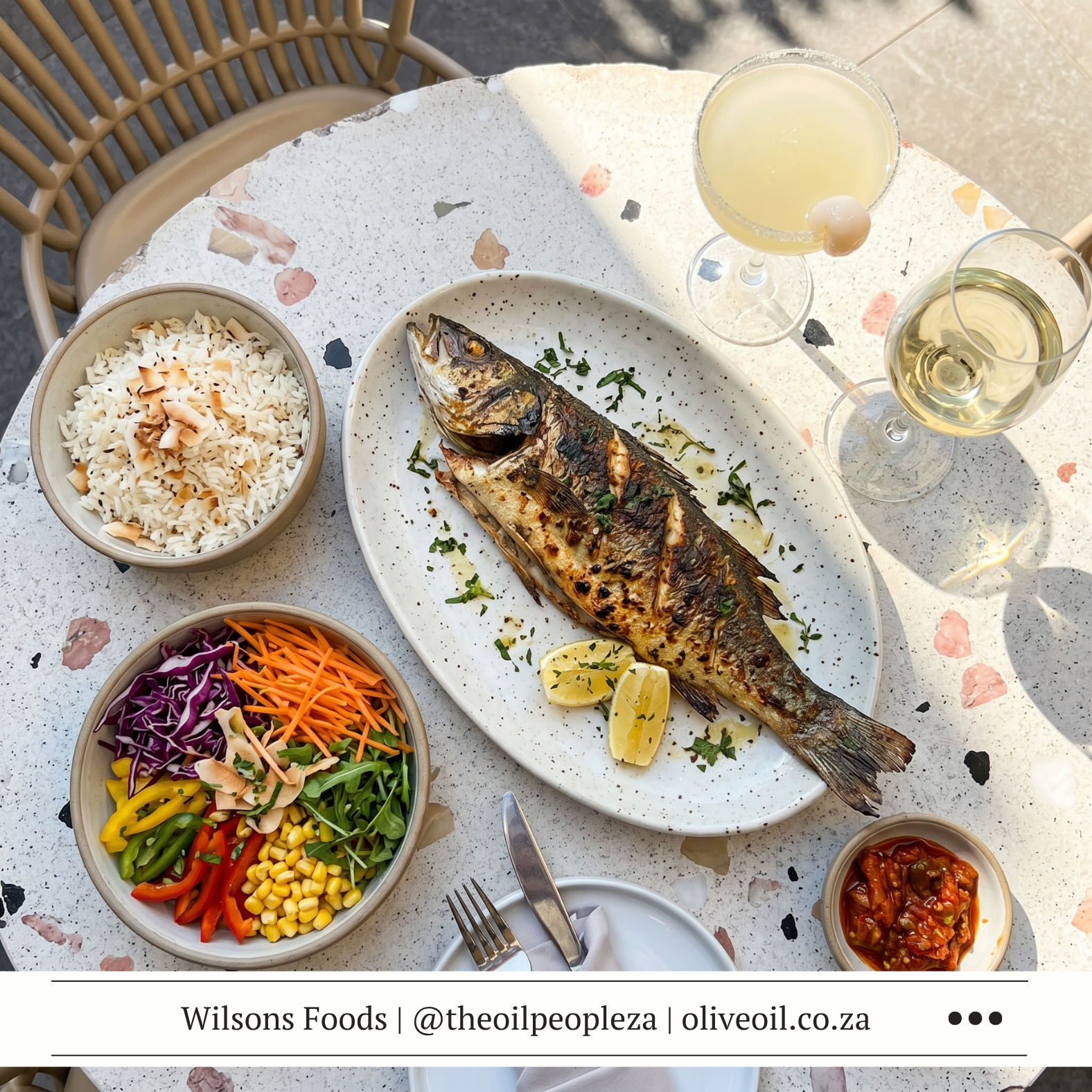
Malaysian Style Whole Fish
Ingredients
Method
- Preheat the oven to 220°C/425°F/gas 7.
- Whack the lemongrass against your work surface and remove the tough outer layer. Roughly chop the lemongrass, shallot, ginger and chillies. Add to a large pestle and mortar with a good pinch of sea salt and the lime leaves and pound to a paste.
- Toast the peanuts in a dry pan over medium heat for 3 minutes until golden. Bash half into the paste. Add the tomato purée, fish sauce and Wilson’s Ginger Flavoured Lime Juice, then mix to combine.
- Score the sea bass skin at 1cm intervals in a criss-cross pattern. Rub the paste all over the fish, inside and out.
- If using a banana leaf, hold it briefly over a gas flame to make it pliable and release its oils. Place the fish in the centre, fold over and seal snugly. Alternatively, use a double layer of baking paper. Place on a baking tray and roast for 25 minutes until the flesh is succulent and comes away from the bone easily.
- For the rice: heat the oil in a saucepan over medium heat. Crumble in the creamed coconut and add the Wilson’s Ginger Flavoured Lime Juice. Tip in the rice and fry for 2 minutes, then pour over 1 mug of boiling water. Turn heat to low, cover and cook for 12 minutes. Remove from heat and steam, covered, for a further 3 minutes.
- For the chilli pickle: combine the sliced chillies, sugar, vinegar and a pinch of salt in a small bowl. Set aside.
- For the salad: place the grated coconut in a serving bowl. Add the sugar snaps, mangetout, both cabbages, cucumber and mango. Pick in most of the herb leaves. Squeeze over the lime juice and toss together.
- Unwrap the fish onto a serving platter. Crush the remaining peanuts and scatter over the fish and salad. Drizzle the fish with soy sauce and scatter over the remaining herbs.
- Bring everything to the table and let people help themselves.
Notes
We Use Wilson’s Ginger Flavoured Lime Juice
Wilson’s Ginger Flavoured Lime Juice does two things in this recipe. In the paste, it adds the citrus brightness that the lime leaves start and the ginger amplifies — a concentrated hit that works its way into the flesh as the fish roasts. In the coconut rice, a tablespoon stirred in early lifts what can otherwise be a heavy, sweet base and keeps it light enough to eat alongside everything else on the table.
It’s a concentrate, so a little carries a lot of flavour. One tablespoon in the paste, one in the rice — that’s all it takes. It doesn’t compete with the lemongrass or the chilli. It sits underneath them and keeps things lively.
Because it’s going into a paste that gets rubbed into the fish before roasting, the heat isn’t a concern here — the citrus integrates into the paste rather than sitting on top of the dish the way a fresh lime squeeze would at the end. Different role, same result: the fish tastes bright all the way through.
A Few Tips
Score the fish properly — cut right through the skin at 1cm intervals in a criss-cross pattern. Shallow scores mean the paste sits on top rather than penetrating the flesh. Go deep enough that you can see the flesh through each cut.
Toast the peanuts first — three minutes in a dry pan until golden makes a real difference to the paste. Raw peanuts are flat; toasted ones bring a roasted depth that carries through the whole dish.
Use the banana leaf if you can find one — Asian supermarkets stock them, usually frozen. Hold it over a gas flame for a few seconds to make it pliable and release the oils. The leaf keeps the steam in and adds a subtle green fragrance that baking paper genuinely cannot replicate.
Get the rice going before the fish comes out — the rice takes 15 minutes from start to finish and should be steaming off the heat while you unwrap the fish. Time it so both land on the table at the same moment.
Make the pickle early — the chilli pickle improves with even 20 minutes sitting time. Make it first, before anything else, and leave it on the counter while you prep everything else.
How We Serve It
The fish comes to the table still wrapped — unwrapping it at the table is part of the experience. The steam and the smell that hits when you open the leaf is half the reason to bother finding a banana leaf in the first place. Unwrap it onto a serving platter, scatter over the crushed peanuts and the remaining herbs, drizzle with soy sauce, and put it in the middle.
The rice goes in a bowl alongside, the chilli pickle in a small dish, and the rainbow salad on its own platter. It’s a proper spread — four components, all ready at the same time. That’s the only logistical challenge, and the recipe notes above handle it.
Everyone serves themselves. That’s the point. A whole fish in the middle of the table with rice and salad and pickle alongside is the kind of meal that keeps people at the table for a while.
More Ways to Use Wilson’s Ginger Flavoured Lime Juice
The same bottle that goes into a Malaysian fish paste works across a wide range. Wilson’s Ginger Flavoured Lime Juice is a concentrate — ginger and lime in one, a tablespoon at a time. A few ideas:
Prawn marinade — a tablespoon with olive oil, garlic and a pinch of chilli makes a quick marinade for prawns that go on the braai or in a griddle pan.
Lamb curry finish — stir a tablespoon into a long-cooked lamb curry right at the end, off the heat, for a citrus lift that cuts through the richness. Get the recipe.
Asian-style dressing — whisk one tablespoon with soy sauce, sesame oil and a little honey for a dressing that works on noodle salads, cucumber salads or anything going in the direction of Southeast Asia.
Mocktail base — a tablespoon in sparkling water with fresh mint and ice. Effortless, and works for anyone not drinking at the table.
Coconut rice — stir a tablespoon into the pan when you fry the creamed coconut and rice before adding water. It lifts the whole base and keeps the rice from going heavy.
The Good Stuff
Wilson’s Ginger Flavoured Lime Juice is a concentrate made with real lime juice and natural ginger flavouring. It’s dairy-free, vegan, gluten-free, Halaal certified, Kosher certified and suitable for Hindu diets. Contains sulphur dioxide — produced in a facility that also processes peanut oil, sesame seed oil and mustard. Store in a cool, dry place away from sunlight, shake well before use, and refrigerate once opened.
Ways to Change It Up
Swap the fish — the same paste and method works well with whole red snapper or whole yellowtail, both of which are readily available from South African fishmongers and the Woolworths fresh fish counter.
Use fillets instead — if a whole fish isn’t your preference, rub the paste onto thick sea bass fillets, wrap individually in banana leaf or foil, and roast at 220°C for 12–15 minutes.
Cook it on the braai — the wrapped fish goes directly onto a grid over medium coals. Keep the lid down if you have one, and give it 25–30 minutes. The banana leaf chars slightly and adds a smoky note that the oven can’t give you.
Dial up the heat — leave the seeds in the chillies when making the paste, or add a fourth chilli. The paste base is rich enough to carry serious heat without losing balance.
Make it nut-free — replace the peanuts in the paste with toasted sunflower seeds. The texture changes slightly but the paste still binds and clings to the fish in the same way.
Simplify the sides — if you’re not making the full spread, the fish with just the coconut rice is already a complete meal. The salad and pickle are worth it, but not mandatory.
Questions You Might Have
Where do I find banana leaves in South Africa?
Asian supermarkets stock them, usually in the freezer section. In Johannesburg, try Oriental Plaza or any of the larger Indian grocery stores. Cape Town has good options around the CBD. If you’re stuck, a double layer of baking paper works — you lose the fragrance but the fish steams just as well.
Can I use a different fish?
Yes — whole red snapper, yellowtail or any firm white-fleshed fish works. The weight should be roughly 700–900g for the timing to stay accurate. Ask your fishmonger to scale and gut it.
Can I make the paste ahead?
Yes — the paste keeps in the fridge in a sealed jar for up to 3 days. You can also rub the fish with the paste and refrigerate it for up to 4 hours before cooking; the flavour going into the flesh gets noticeably better the longer it sits.
How do I know when the fish is done?
The flesh should be opaque all the way through and come away from the bone easily when you press it with a fork. At 220°C, an 800g fish takes around 25 minutes wrapped. If yours is larger, add 5 minutes and check again.
I can’t find kaffir lime leaves — what can I use?
Add an extra squeeze of lime juice and a little extra lime zest to the paste. The kaffir lime leaves add a floral citrus note that’s hard to replicate exactly, but the ginger and lemongrass carry the paste without them.
Can I make this for more people?
Yes — roast two fish side by side on the same tray and double the paste. The rice, pickle and salad scale easily. Allow a little extra oven time if the fish are crowded on the tray.
Where can I buy Wilson’s Ginger Flavoured Lime Juice?
Wilson’s Ginger Flavoured Lime Juice is available online at oliveoil.co.za and at leading retailers across South Africa.
This Friday’s Fish is Sorted.
Wilson’s Ginger Flavoured Lime Juice is available online and at leading retailers across South Africa.
Shop Now More RecipesMore From Our Kitchen
Pickled Fish — Snoek on the Braai — Tinned Sardine Puttanesca — Spicy Thai Peanut Chicken — All Recipes
Made this? We’d love to see.
Tag us @theoilpeopleza · #WilsonsFoods