
There’s always a small argument over whose Wellington gets carved first once the festive table’s set, and it’s been going on for years without anyone quite backing down. The version that usually wins is wrapped in prosciutto instead of the usual ham, with porcini folded through the mushroom mix.
The trick is in how the beef gets seared before it goes in the pastry. A hot pan, a good glug of Wilson’s Extra Virgin Olive Oil, and no crowding the fillet. Everything else follows from that first crust.
Here’s how we make ours.
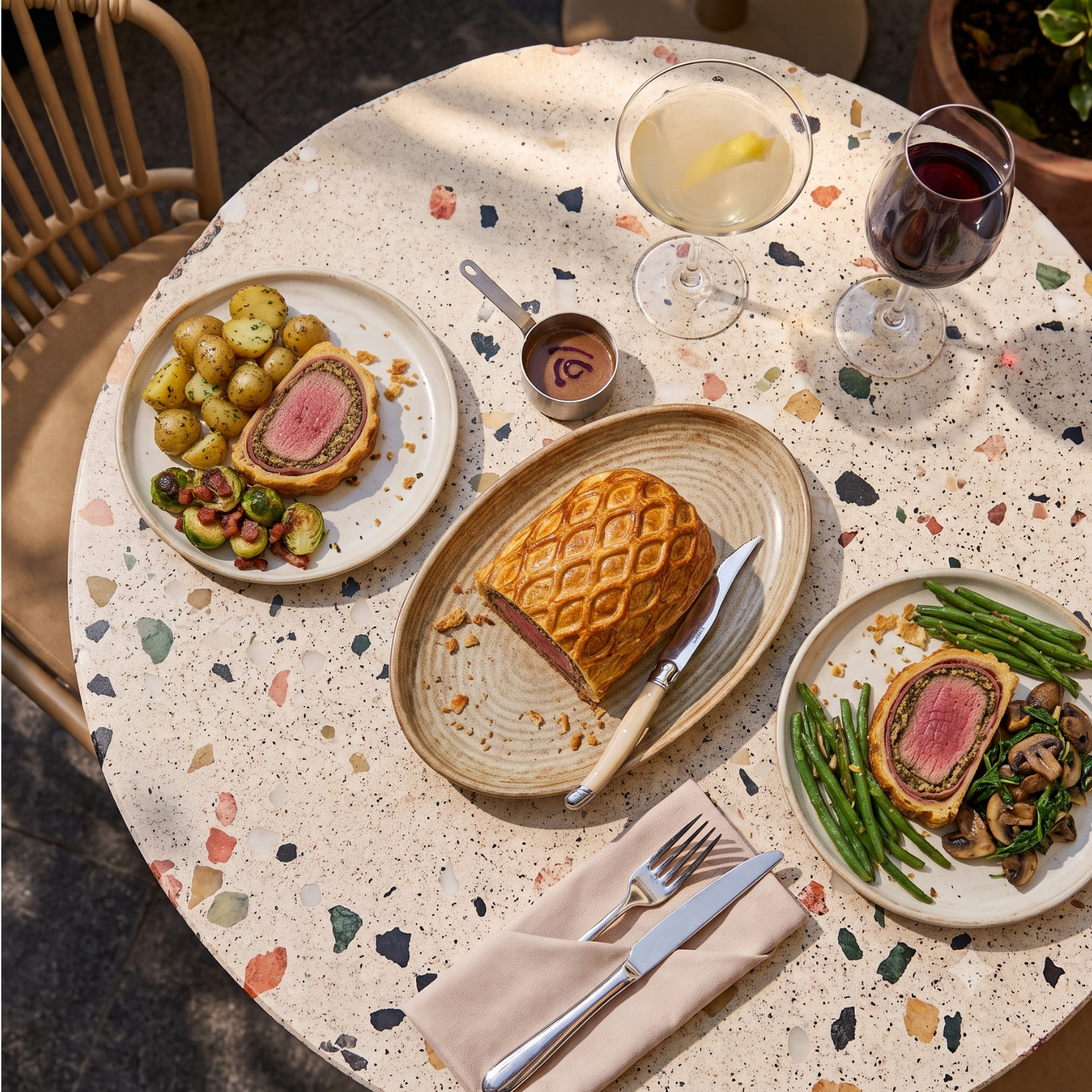
Italian-Style Beef Wellington
Ingredients
Method
- Pat the beef fillet dry and season generously with salt and pepper.
- Heat 2 tablespoons of Wilson’s Extra Virgin Olive Oil in a heavy pan over high heat. Sear the fillet on all sides until deeply browned, about 6–8 minutes total. Remove and set aside to cool. Brush all over with the Dijon mustard once cooled.
- Drain the soaked porcini, reserving the liquid, and chop finely. In the same pan, heat the remaining olive oil and cook the onion and garlic over medium heat until soft, about 4 minutes.
- Add the fresh mushrooms, porcini, and prosciutto to the pan. Cook over medium-high heat, stirring often, until the mixture is dry and deeply golden, about 12–15 minutes.
- Pour in the white wine and 2 tablespoons of the reserved porcini liquid. Cook until fully evaporated. Stir through the thyme and Parmesan, season to taste, and leave the duxelles to cool completely.
- Lay a large sheet of cling film on the counter. Arrange the prosciutto slices in an overlapping layer, large enough to wrap the fillet. Spread the cooled duxelles evenly over the prosciutto.
- Place the seared fillet in the centre and use the cling film to roll the prosciutto and duxelles tightly around it, twisting the ends to seal. Chill for at least 20 minutes to firm up.
- Roll out the puff pastry on a lightly floured surface. Unwrap the beef and place it in the centre of the pastry. Brush the pastry edges with egg wash, then fold and wrap fully around the beef, trimming excess and sealing the seams.
- Turn the parcel seam-side down onto a lined baking tray. Brush all over with egg wash and score a light pattern across the top with a sharp knife. Chill for 15 minutes.
- Preheat the oven to 200°C. Brush the pastry with a second coat of egg wash and bake for 35–40 minutes, until the pastry is deep golden and a meat thermometer inserted into the centre reads 50–52°C for medium-rare.
- Rest the Wellington for 10–15 minutes before carving into thick slices with a serrated knife.
Notes
- Make-ahead: The wrapped, unbaked Wellington can be assembled up to a day ahead and kept chilled, tightly wrapped, until ready to bake.
- Storage: Leftovers keep in an airtight container in the fridge for up to 2 days.
- Freezing: Freeze the assembled, unbaked Wellington for up to 1 month. Thaw fully in the fridge overnight before baking.
- Resting and carving: Always rest before carving — this keeps the juices in the meat rather than on the board. Use a sharp serrated knife and a gentle sawing motion to keep the pastry from crushing.
We Use Wilson’s Extra Virgin Olive Oil
Getting a proper crust on the fillet matters more than most people think. We sear it hard and fast in Wilson’s Extra Virgin Olive Oil, which handles the high heat well and leaves the beef with real colour on every side before it’s wrapped.
The same oil goes into the duxelles, where it carries the porcini and prosciutto through a long, slow cook until the mixture turns dark and dry. That’s what keeps the pastry from turning soggy underneath.
A light brushing on the pastry seams before baking helps everything seal and colour evenly, so the whole parcel comes out an even, deep gold.
Our Tips
Get the pan properly hot — the fillet should sizzle the second it touches the oil, otherwise it steams instead of browning.
Cool the duxelles fully before wrapping — warm mushroom mixture will soften the pastry before it’s even in the oven.
Chill the parcel before baking — twenty minutes in the fridge firms up the butter in the pastry and helps it hold its shape.
Use a meat thermometer — pull it at 50–52°C for a proper medium-rare centre once it’s rested.
Rest it properly — ten to fifteen minutes under foil keeps the juices where they belong instead of pooling on the board.
Assemble it the day before if your table is already busy — wrap it tightly and chill it, then bake it fresh on the day.
How We Serve It
We bring it to the table whole and carve it there, so everyone sees the pink centre before it hits the plate. A serrated knife and a slow hand keep the slices clean.
Alongside it we like roast potatoes done properly crisp, some buttered greens, and a jug of red wine jus poured at the table. If it’s a Cape Town summer Christmas, a simple green salad does the job just as well.
It’s substantial enough to carry the whole main course, so we tend to keep the rest of the table simple around it.
More Ways to Use Wilson’s Extra Virgin Olive Oil
Once the bottle of Wilson’s Extra Virgin Olive Oil is open for the Wellington, it’s worth putting it to work elsewhere over the festive season.
Slow Roast Rack of Lamb — another festive main that leans on a good sear and a slow finish in the oven.
Steak & Onion Sandwich — a good use for any trimmed-off beef from the fillet.
Three Flavour Focaccia — bread for the table while everyone waits for the Wellington to rest.
Biltong and Caprese Salad — a lighter starter before a rich main.
Marinated Mediterranean Olives — something to nibble while the oven does the work.
The Good Stuff
Wilson’s Extra Virgin Olive Oil is Halaal and Kosher certified, and suitable for vegan, vegetarian and Hindu diets. It’s a straightforward, versatile oil that works as hard in a hot pan searing beef as it does finishing a salad.
It’s available in a range of pack sizes, from a 250ml bottle up to a 5L for anyone doing a lot of festive cooking.
Ways to Change It Up
Make individual portions — wrap single fillet steaks in their own pastry parcels for a plated starter instead of one large roast.
Swap the mushroom mix — try dried porcini with fresh portobello instead of brown mushrooms for a deeper, earthier duxelles.
Use a different cured meat — pancetta or bresaola both work in place of prosciutto if that’s what’s in your fridge.
Add a layer of pesto — a thin spread under the duxelles brings a brighter, more herbaceous edge to the filling.
Freeze it ahead — assemble the whole parcel, wrap it well, and freeze it up to a month out from your festive lunch.
Questions You Might Have
Why did my pastry go soggy on the bottom?
It usually comes down to moisture in the duxelles. Cook the mushroom mixture until it’s properly dry, not just softened, and make sure it’s fully cooled before it touches the pastry.
What temperature should the beef be when it comes out of the oven?
Pull it at 50–52°C for medium-rare, since it’ll climb a few more degrees while it rests. For medium, aim closer to 57°C.
Can I make it ahead of time?
Yes. Assemble the full parcel a day ahead and keep it tightly wrapped in the fridge, then bake it fresh when you’re ready to eat.
What if I can’t find prosciutto?
Parma ham or a good streaky bacon both work as substitutes, though the flavour will be slightly less delicate.
Why does the recipe use cling film to wrap the duxelles and prosciutto?
It helps you roll everything tightly around the beef and holds its shape while it chills, which makes wrapping the pastry much easier later.
Can I freeze leftovers once it’s baked?
We’d rather freeze it unbaked. Baked pastry doesn’t always crisp back up the same way after freezing and reheating.
What size fillet should I buy for six people?
A 1kg centre-cut fillet is a good fit for six generous slices, with a little room for seconds.
Where can I buy Wilson’s Extra Virgin Olive Oil?
It’s available to order directly from oliveoil.co.za and at leading retailers across South Africa.
More From Our Kitchen
Slow Roast Rack of Lamb — Slow-Braised Oxtail Stew — A Mother’s Day Lunch Recipes — All Recipes
Made this? We’d love to see
Tag us @theoilpeopleza · #WilsonsFoods