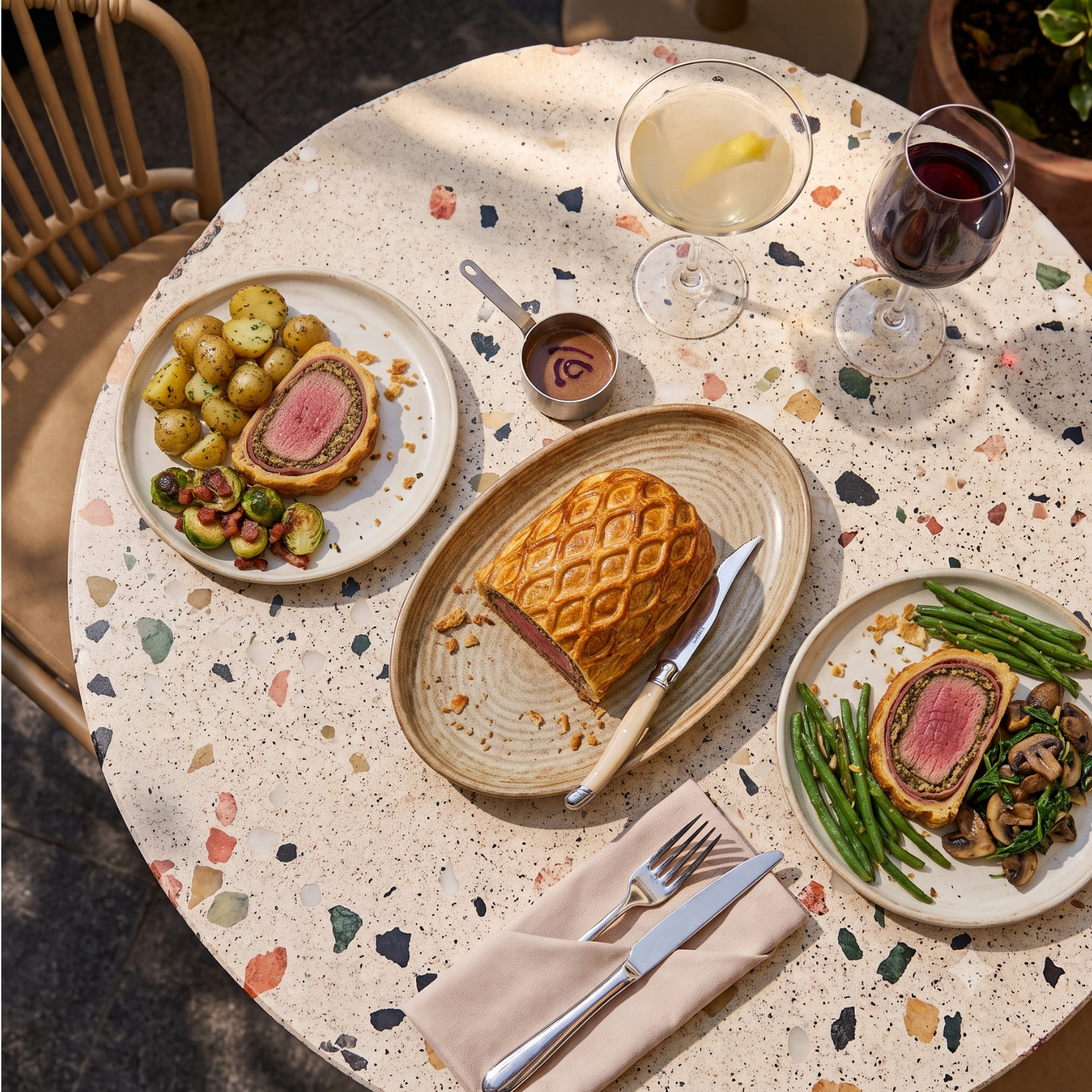
Pat the beef fillet dry and season generously with salt and pepper.
Heat 2 tablespoons of Wilson’s Extra Virgin Olive Oil in a heavy pan over high heat. Sear the fillet on all sides until deeply browned, about 6–8 minutes total. Remove and set aside to cool. Brush all over with the Dijon mustard once cooled.
Drain the soaked porcini, reserving the liquid, and chop finely. In the same pan, heat the remaining olive oil and cook the onion and garlic over medium heat until soft, about 4 minutes.
Add the fresh mushrooms, porcini, and prosciutto to the pan. Cook over medium-high heat, stirring often, until the mixture is dry and deeply golden, about 12–15 minutes.
Pour in the white wine and 2 tablespoons of the reserved porcini liquid. Cook until fully evaporated. Stir through the thyme and Parmesan, season to taste, and leave the duxelles to cool completely.
Lay a large sheet of cling film on the counter. Arrange the prosciutto slices in an overlapping layer, large enough to wrap the fillet. Spread the cooled duxelles evenly over the prosciutto.
Place the seared fillet in the centre and use the cling film to roll the prosciutto and duxelles tightly around it, twisting the ends to seal. Chill for at least 20 minutes to firm up.
Roll out the puff pastry on a lightly floured surface. Unwrap the beef and place it in the centre of the pastry. Brush the pastry edges with egg wash, then fold and wrap fully around the beef, trimming excess and sealing the seams.
Turn the parcel seam-side down onto a lined baking tray. Brush all over with egg wash and score a light pattern across the top with a sharp knife. Chill for 15 minutes.
Preheat the oven to 200°C. Brush the pastry with a second coat of egg wash and bake for 35–40 minutes, until the pastry is deep golden and a meat thermometer inserted into the centre reads 50–52°C for medium-rare.
Rest the Wellington for 10–15 minutes before carving into thick slices with a serrated knife.