
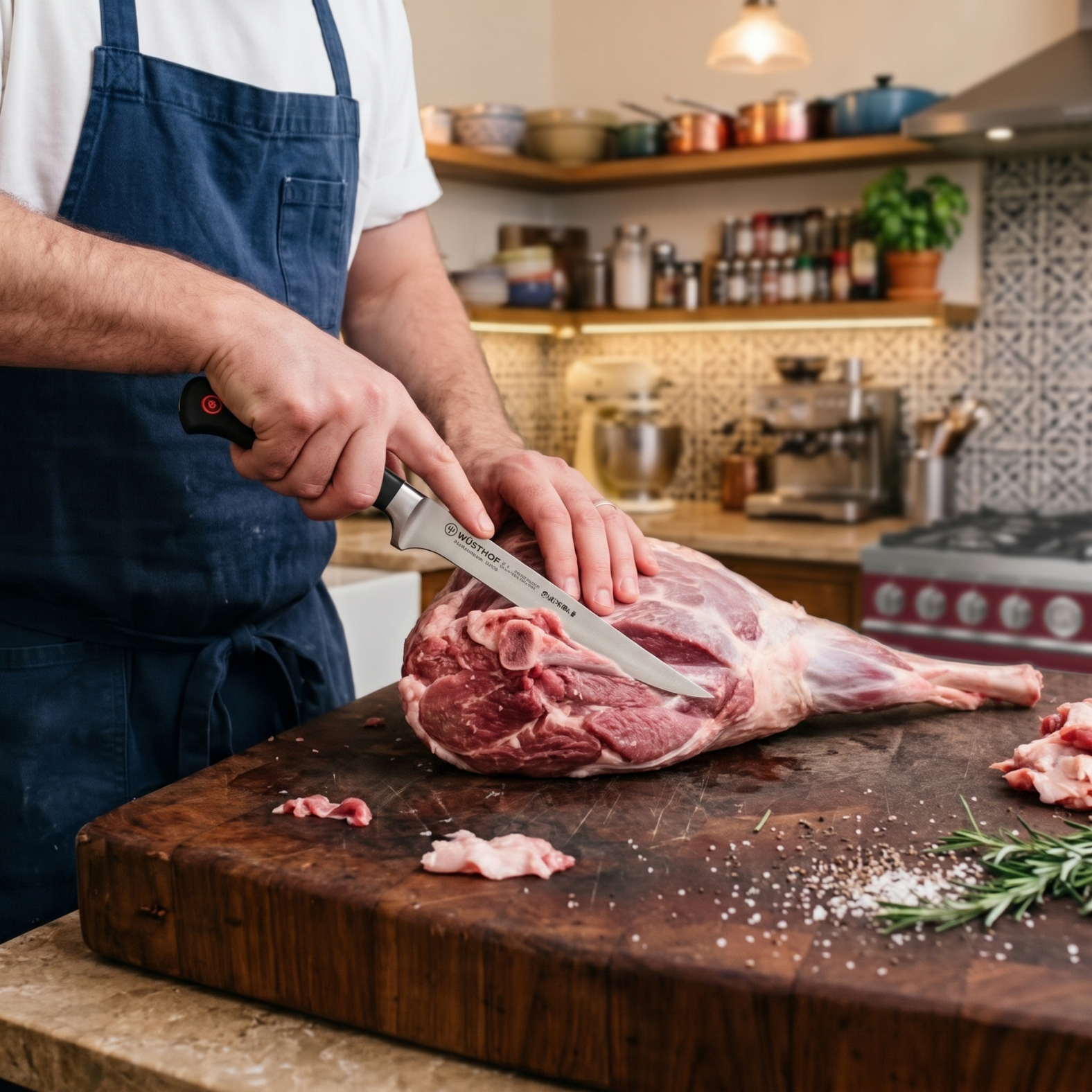
Any butcher worth his salt can debone a leg of lamb in under two minutes. But why deboned? A whole leg, bone in, fights you the entire way through a braai or an oven — thick at the top, thin at the shank, done in the middle long before the ends catch any colour. Take the bone out and open the meat up flat, and that same leg turns into a single, even slab that cooks at roughly the same rate all over.
It looks like a job for a trained butcher the first time you watch it done, but it’s really just a handful of cuts followed in the right order, close against the bone the whole way. Once you can feel where the bone sits under the meat, the rest is patience more than skill. A marinade helps once the leg is open — rosemary and lamb have been a firm favourite for centuries, and a basting oil like Wilson’s Rosemary Flavoured Oil carries that pairing through a marinade or a baste far more evenly than loose dried herbs.
Now let’s “get to the meat of it!” Here’s how to debone a leg of lamb properly, step by step, so it opens out flat and ready for the fire.
What You’ll Need
A sharp boning knife makes this job far easier than a general kitchen knife. The thin, flexible blade follows the curve of the bone without taking chunks of meat along with it. Beyond that, you need a large chopping board, a clean kitchen towel to grip the leg as you work, and a bowl for the trimmings.
A whole leg of lamb, bone in, is the starting point. Ask the butcher for the aitchbone removed already if you can — it saves one of the fiddlier early cuts.
How to Debone a Leg of Lamb
Lay the leg skin-side down on the board. Run the knife along the line of fat that tracks the length of the bone, cutting through to expose it from end to end. This first cut sets up every one after it, so take it slowly and keep the blade shallow.
Starting at the wider, hip end, work the knife tip around the pelvic bone, scraping it clean rather than hacking at it, until it separates from the meat. Lift that piece out and set it aside.
With the pelvic bone out, follow the leg bone down toward the knee joint, keeping the knife flat against the bone the whole way so as little meat as possible stays attached to it. Cut through the tendons at the knee joint to free the bone from the shank end, then pull the whole bone out in one piece.
Trim away any cartilage, silverskin or large knots of fat left behind once the bone is out. The leg should now lie open like a rough book, thick in some places and thin in others.
To even it out, lay the knife flat against the thickest part and slice horizontally, not all the way through, then open that cut out like a second page. The leg should now sit at roughly the same thickness across the whole piece, ready for a butterflied braai or a quick roast.
Our Tips
Keep the knife close to the bone. Every centimetre of distance from the bone is meat left behind on the trimmings pile instead of on the leg.
Use short strokes, not long ones. Small, controlled cuts give you far more feel for where the bone actually is than one long sweeping cut.
Chill the lamb first. A leg that’s cold but not frozen holds its shape under the knife far better than one at room temperature.
Work on a towel, not bare board. A damp kitchen towel under the board stops it sliding around while your hands are busy holding the meat steady.
Save the bone. It makes a proper stock once the meat’s off it, so don’t bin it with the trimmings.
Marinate once it’s open, not before. A flat, boned leg takes on a marinade far faster than a whole one, since there’s far more surface exposed to it.
What to Do With a Butterflied Leg
An open, boned leg goes straight onto the braai or under a hot grill, fat-side up first so it renders before the meat catches too much colour. Because it’s an even thickness all over, you get a far more consistent result edge to edge than you would carving a whole roasted leg, where the ends are always further along than the middle.
A marinade of red wine, garlic, lemon and Wilson’s Rosemary Flavoured Oil is as classic a pairing as lamb gets. A few hours is enough, but an overnight marinade in the fridge reaches further into the flat, open meat than it ever could into a whole leg.
Once it’s rested and sliced against the grain, a butterflied leg carves far more easily than one still on the bone, with none of the awkward angles around the joint to work around.
Common Mistakes to Avoid
Cutting too far from the bone. It feels safer, but it leaves good meat behind on a bone that’s heading for the stockpot anyway.
Rushing the knee joint. It’s the fiddliest part of the whole job. Take it slowly and cut around the tendons rather than through the bone itself.
Skipping the evening-out cut. A leg left at uneven thickness cooks unevenly no matter how well the bone came out.
Using a blunt knife. A dull blade drags through the meat instead of slicing it cleanly, which makes it far harder to feel the bone underneath.
Tying it straight away. If you’re rolling and tying the leg for roasting, let the marinade get in first while it’s still open, then roll it just before it goes into the oven.
Questions You Might Have
What knife should I use to debone a leg of lamb?
A boning knife, with its thin, flexible blade, is the right tool. A standard chef’s knife works in a pinch but is harder to control close against the bone.
Can I ask my butcher to debone the leg for me?
Yes, most butchers will do this on request, often at no extra cost. It’s still worth knowing the technique for the times you’ve already got the whole leg at home.
What’s the difference between deboning and butterflying?
Deboning just means removing the bone. Butterflying goes a step further, opening the meat out flat so it’s an even thickness all over, ready for quick, even cooking.
How long does a boned, butterflied leg take to cook?
On a hot braai or grill, around 30 to 40 minutes total, turning regularly, compared to well over an hour for a whole leg on the bone.
Can I freeze the bone for stock later?
Yes, wrapped well it keeps in the freezer for up to 3 months, ready for whenever you’ve got time to simmer a proper stock.
What should I marinate a butterflied leg of lamb in?
Garlic, lemon and rosemary are the classic combination with lamb. A marinade built on Wilson’s Rosemary Flavoured Oil carries that flavour evenly through the meat and keeps it from drying out over the fire.
Where can I buy Wilson’s Rosemary Flavoured Oil?
It’s available to order directly from oliveoil.co.za and at leading retailers across South Africa.
Ready to Make This?
Get the rosemary oil that turns a freshly boned leg into a proper braai marinade.
More From Our Kitchen
Braai Lamb Chops — Greek Lamb Chops — Lamb Potjie — All Recipes
Made this? We’d love to see
Tag us @theoilpeopleza · #WilsonsFoods